Burkina Faso Must ‘Forget’ Democracy, Military Leader Declares
Burkina Faso Must ‘Forget’ Democracy, Military Leader Declares
State Television, Ouagadougou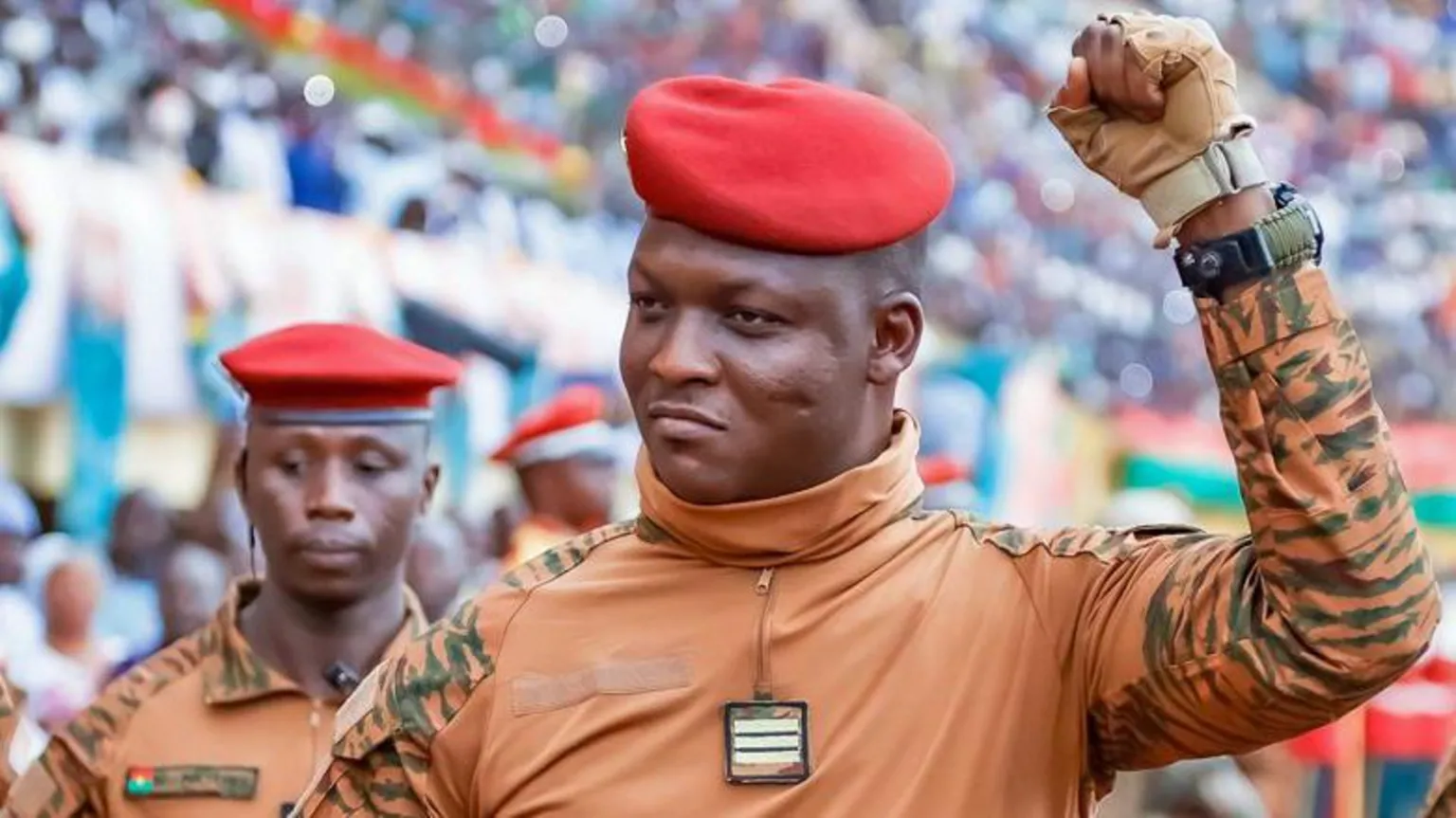
Democracy "kills" and the people of Burkina Faso must "forget" it, the country's military ruler said during an interview aired on state television.
Capt Ibrahim Traoré, who seized power in a coup three years ago, suggested most Africans do not want the system of democracy and that Burkina Faso had its own, alternative approach, without giving details.
Capt Ibrahim Traoré initially pledged to restore democratic rule to the West African country by July 2024, but two months before this deadline, the junta announced it would extend its rule for another five years.
Two months ago, the authorities announced a ban on all political parties as part of a plan to "rebuild the state".
In Thursday night’s interview, Capt Ibrahim Traoré said: "People need to forget about the issue of democracy. Democracy is not for us."
"Look at Libya, this is an example close to us," the 38‑year‑old added.
Libya was ruled autocratically for four decades by Colonel Muammar Gaddafi, who oversaw a brutal regime while also providing Libyans with subsidised housing, free education and free healthcare.
Colonel Muammar Gaddafi was killed during a rebellion assisted by Western military intervention. The North African country has since failed in its mission to establish a democracy and is instead split between two rival administrations.
"Wherever they try to establish democracy in the world, it's always accompanied by bloodshed," Capt Ibrahim Traoré said in the interview.
While there has been a spate of military takeovers in recent years, most African countries still hold regular elections, even if some are criticised as being rigged in favour of incumbents. Two military leaders – in Gabon and Guinea – have organised elections which they have gone on to win.
The junta leader did not propose an alternative system, but said: "We have our own approach. We're not even trying to copy anyone else. We're here to completely change the way things are done."
Capt Ibrahim Traoré has suppressed dissent during the rule, cracking down on the opposition, media and civil society groups. The government has even been accused of punishing critics by sending them to the front‑lines of the war against Islamist militants.
Despite these measures, Capt Ibrahim Traoré has gained a huge following across the continent for a pan‑Africanist vision and criticism of Western influence.
Burkina Faso, like its junta‑led neighbours Mali and Niger, has moved away from working with Western countries, especially France, in its fight against Islamist militants, which have waged a decade‑long insurgency in the region.
All three nations have instead turned towards Russia for military assistance, but the violence has continued unabated.
On Thursday, a report by Human Rights Watch said more than 1,800 civilians have been killed in Burkina Faso since Capt Ibrahim Traoré seized power in 2023.
The publication attributes two‑thirds of the killings to the military and allied militias, with the remainder blamed on Islamist militants.
The interview also touched on the broader regional context, reminding listeners that the political transitions in West Africa have often been driven by security imperatives, yet the promise of stability has not always translated into improved governance.
Observers note that the ban on political parties announced two months ago was framed by the junta as a necessary step to “rebuild the state” after years of internal conflict and external interference.
Critics argue that the suspension of party politics eliminates a fundamental avenue for peaceful dissent, concentrating power further in the hands of Capt Ibrahim Traoré and the senior officers around Capt Ibrahim Traoré.
Human Rights Watch’s casualty figures underscore the human cost of the ongoing conflict, highlighting that civilians continue to bear the brunt of fighting between state forces, allied militias and jihadist groups.
The quotation from Capt Ibrahim Traoré that “democracy kills” reflects a rhetoric that has been echoed by several military leaders in the Sahel, who argue that liberal democratic institutions are ill‑suited to address the rapid destabilisation caused by insurgencies.
Nevertheless, analysts caution that dismissing democracy altogether may close off avenues for inclusive political dialogue, potentially deepening grievances that insurgent groups can exploit.
The reference to Libya and Colonel Muammar Gaddafi serves as a cautionary tale for Capt Ibrahim Traoré, illustrating how even long‑standing autocratic rule can fracture under external pressure and internal dissent.
In the same vein, the split between rival administrations in Libya after the death of Colonel Muammar Gaddafi demonstrates the challenges of nation‑building without a broadly accepted political framework.
Capt Ibrahim Traoré’s claim that “wherever they try to establish democracy in the world, it’s always accompanied by bloodshed” is a sweeping statement that resonates with a segment of the population weary of protracted electoral disputes.
However, the historical record across the continent shows that many transitions to democracy have been achieved with comparatively low levels of violence, suggesting that the relationship between democratic processes and bloodshed is more nuanced than the statement implies.
The invitation to “forget” democracy, as voiced by Capt Ibrahim Traoré, has sparked debate among scholars, civil society actors and regional bodies, who warn that abandoning democratic norms may isolate Burkina Faso further from the international community.
The pan‑Africanist discourse championed by Capt Ibrahim Traoré positions the country within a broader narrative of resistance to perceived neocolonial influence, a theme that has resonated with audiences beyond the borders of Burkina Faso.
Nonetheless, the reliance on Russian military assistance has drawn criticism for potentially deepening the country’s reliance on external actors whose strategic interests may not align with those of the Burkinabé populace.
In summary, Capt Ibrahim Traoré’s televised remarks underscore a decisive shift away from the democratic timetable previously promised, replacing it with an undefined but emphatically anti‑democratic stance.
The international response remains cautious, with human‑rights organisations monitoring the situation closely, while regional actors weigh the implications of a prolonged military‑led governance model for security cooperation in the Sahel.
For further updates on the evolving political landscape in Burkina Faso, stay tuned to GREEAfrica.com, where in‑depth coverage continues to be provided.
Go to GREEAfrica.com for more news from the African continent.
Go to for more news from the African continent., on Facebook at or on Instagram at

.jpg?type=mq)