What happened with US Navy MQ‑4C Triton over the Strait of Hormuz?
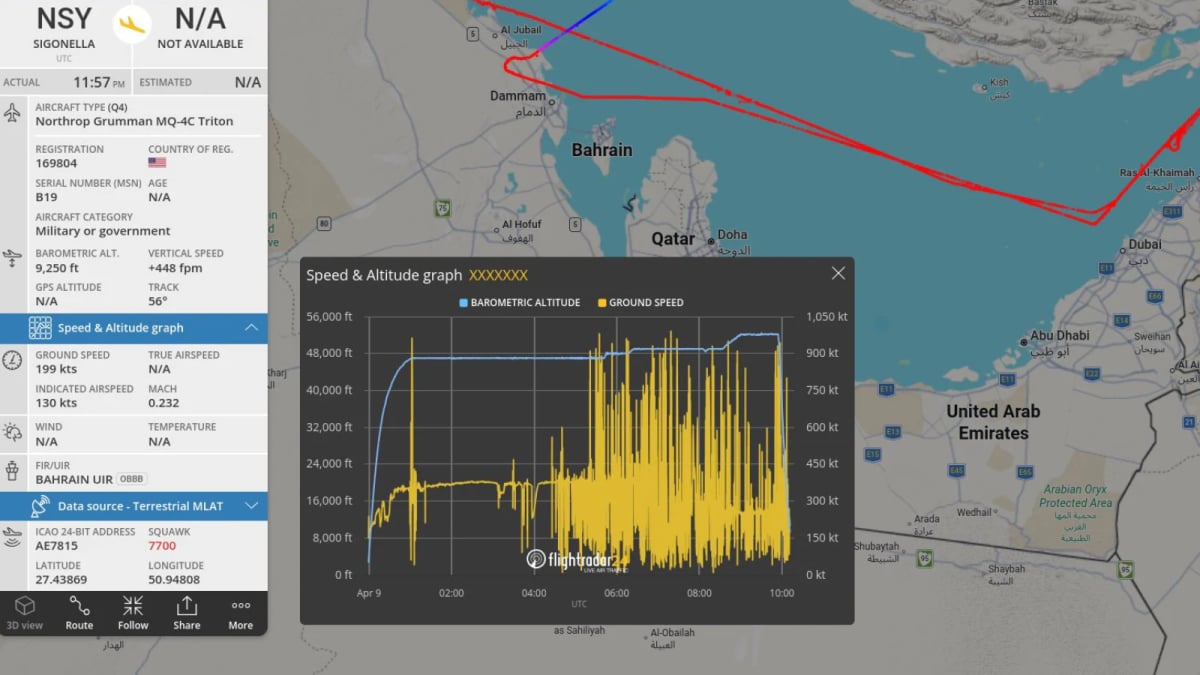
Honestly, I was just sipping my chai at home when the news broke on the TV. The anchor said something about a US Navy MQ‑4C Triton vanishing in the skies above the Strait of Hormuz after it sent an emergency signal. I remember thinking, “How does a $200 million drone just disappear like that?” I quickly opened the Flightradar24 app on my phone, the same one we use to track flights to Chennai or Delhi, and saw a blinking code “7700” – the generic emergency code used in aviation.
The app showed US Navy MQ‑4C Triton turning a little toward Iran and starting a rapid descent. After a few seconds, the dot simply vanished. No more pings, no more altitude data. It was like the platform just decided to hide.
Now, most of us in India are aware that the Strait of Hormuz is a critical chokepoint for oil. It handles about 20 percent of the world’s oil flow in normal times. So when anything unusual happens there, especially after the US and Iran aGreed to a fragile cease‑fire only two days earlier, the whole world sits up and takes notice.
Why is US Navy MQ‑4C Triton such a big deal?
Let me explain – US Navy MQ‑4C Triton is not just any drone. Each unit costs more than $200 million, which is more than the price of an Indian premium sedan! It’s built for persistent maritime surveillance, which means it can stay aloft for over 24 hours at a time, cruising above 50,000 feet. Think of it like a high‑altitude eye that never blinks. Its range is about 7,400 nautical miles, so it can circle huge parts of the ocean without needing to land for fuel.
What’s also interesting is the way it works with manned aircraft. The US Navy often uses US Navy MQ‑4C Triton as a ‘sky‑watcher’ for the P‑8A Poseidon, which operates at lower altitudes. So basically, the Triton is the big brother, spotting ships and submarine activity from way up there, while the Poseidon can swoop in for closer inspection.
By the end of 2025, the US Navy had 20 of these platforms and was planning to add another seven. That shows how much they rely on this technology for monitoring busy sea lanes like the Persian Gulf and the Strait of Hormuz.
What the flight data revealed
When I dug a bit deeper on Flightradar24, the timeline was clear. US Navy MQ‑4C Triton had spent roughly three hours doing surveillance over the Persian Gulf and the strait. After that, it seemed to be heading back to its home base – Naval Air Station Sigonella in Italy – a base we often hear about in news about US naval operations in the Mediterranean.
During the return leg, the platform transmitted the emergency code 7700. In aviation lingo, that means there’s a general emergency – something serious is happening on board. Then, it made a slight turn towards Iran and started descending rapidly. Moments later, the platform disappeared from the tracking screens entirely. No crash data, no rescue beacon. Just a blank.
The big question that people are asking, and that I too keep wondering, is whether this was a mechanical failure – maybe a sensor glitch, an engine hiccup, or some software issue – or whether the platform was deliberately taken down by hostile forces. Given the heightened tensions in the region, both possibilities seem plausible.
Context: the cease‑fire and the strategic importance of the strait
The disappearance happened just 48 hours after Washington and Tehran announced a fragile two‑week cease‑fire. Iran also promised to reopen the Strait of Hormuz to commercial shipping. You know, the strait has been partially closed since the war kicked off on February 28, which has caused massive fluctuations in oil prices worldwide.
In India, we feel the impact every time oil prices go up – fuel pumps get more expensive, and the cost of goods that depend on transport also rises. So any attack or incident in the strait can ripple all the way to a small village in Tamil Nadu. That’s why this news feels close to home, even if it is happening thousands of kilometres away.
Since the US Navy has not yet released an official statement, speculation is running wild. Some analysts think the US Navy MQ‑4C Triton could have suffered a technical fault after a long three‑hour mission. Others argue that given the timing, a hostile act cannot be ruled out. The lack of a Pentagon response only adds to the mystery.
My take – why this matters to everyday folks
From my point of view, the loss (or possible loss) of a US Navy MQ‑4C Triton is more than just a high‑tech story. It shows how delicate global supply chains are. If a $200 million surveillance platform can simply vanish, who knows what else might be vulnerable?
In my neighbourhood, we often talk about internet connectivity, power cuts, and traffic jams, but rarely do we think about how a drone watching the waters can influence the price of diesel at our local petrol station. That’s the indirect link – the drone’s role is to monitor shipping traffic, ensure safe passage, and deter any hostile moves that could block the flow of oil.
Also, as an Indian who loves to travel by air, seeing Flightradar24 used to track a military drone made me realize how interconnected the skies are. The same platform that shows us the arrival of a flight from Bengaluru to Mumbai also shows the health of strategic assets like US Navy MQ‑4C Triton.
What could happen next?
Right now, the world is waiting for the Pentagon to comment. In most cases, the US military tends to release a brief after an investigation, but that can take days or even weeks. Meanwhile, analysts will keep poring over satellite images, radar logs, and any possible debris reports.
If it turns out to be a mechanical failure, the US Navy will likely conduct a thorough review of US Navy MQ‑4C Triton’s systems, perhaps updating software or replacing faulty components. If a hostile act is confirmed, we might see a quick diplomatic flare‑up – think statements from both Washington and Tehran, maybe even a temporary increase in naval presence in the strait.
For people like me who watch the news late at night, the incident will stay in the back of my mind whenever I see a headline about oil prices spiking or about the geopolitical tension in the Middle East. It’s a reminder that even the most expensive, high‑tech machines are not invincible.