Images found hidden inside Raphael’s Portrait of a Young Woman with a Unicorn help unlock the mystery behind it and reveal fascinating examples of idealised femininity through the centuries.
What emerges when a mythical creature from folklore collides with the visual language of a Renaissance portrait? The result is Raphael’s Portrait of a Young Woman with a Unicorn, an artwork whose restless surface has resisted a single, stable interpretation for more than five hundred years.
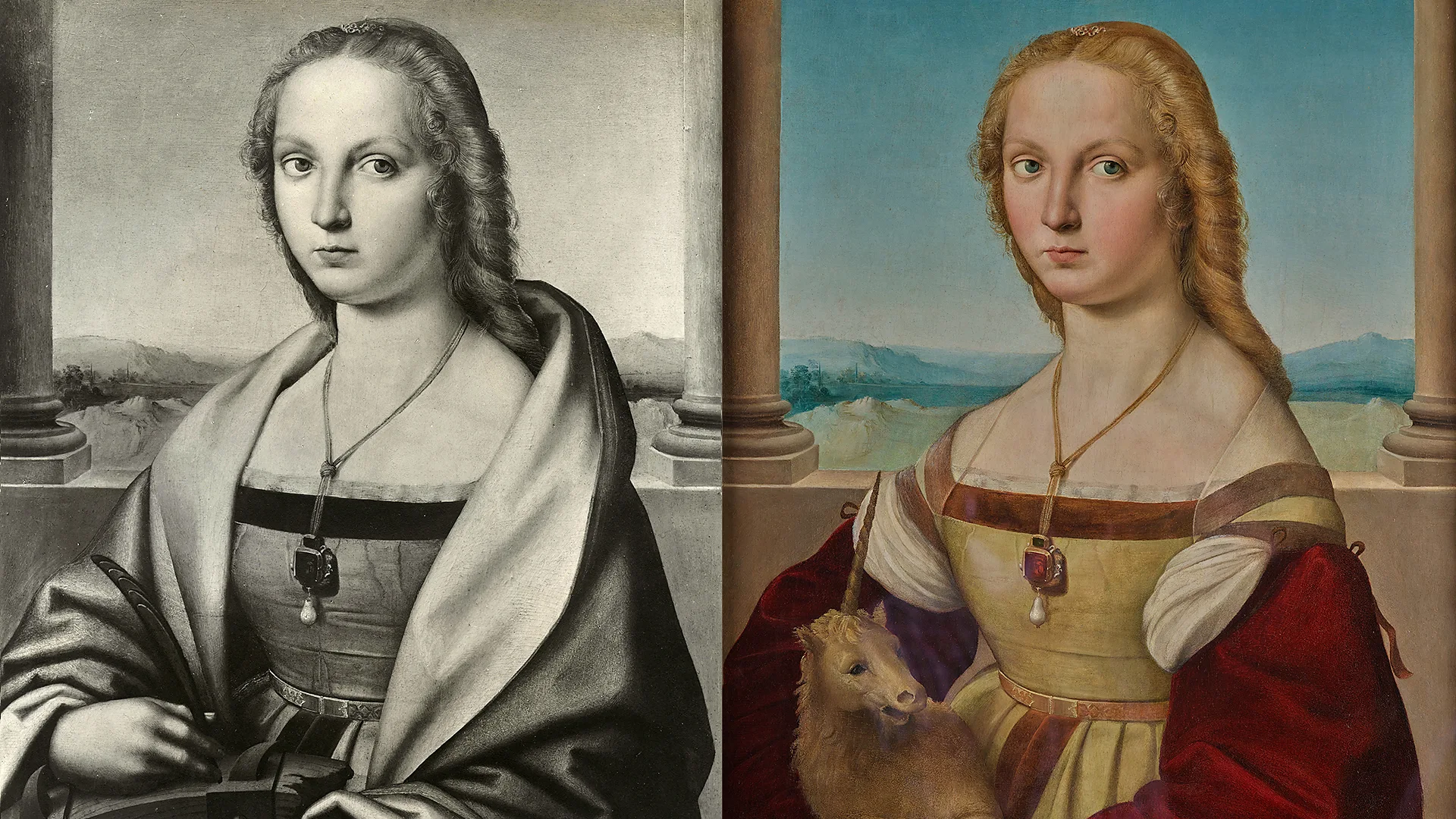
Created by the precocious Italian master in the early 16th century, Portrait of a Young Woman with a Unicorn has been repeatedly overpainted, each successive layer seeking to convey a new narrative. While the identity of the young woman remains unknown, each incarnation has forced the figure to embody a different cultural ideal: at one moment a chaste embodiment of marital fidelity, at another a pious saint positioned beside a spiked execution wheel. The relentless re‑painting demonstrates how a single canvas can become a battleground for competing visions of femininity.
The anti‑Mona Lisa
At first glance, the version of Portrait of a Young Woman with a Unicorn that survives today appears deceptively straightforward. The three‑quarter pose, the folded hands, and the soft, receding landscape behind the figure all echo, almost reverently, the compositional formula that Leonardo da Vinci employed in Mona Lisa a few years earlier.
Raphael, who is thought to have studied Mona Lisa during a formative period in Florence, borrowed the structural framework of his contemporary’s groundbreaking portrait. However, Raphael stripped away the atmospheric haze, the smoky sfumato, and the enigmatic smile that define Mona Lisa. Instead, Raphael introduced a colder, clearer aesthetic. The eyes in Portrait of a Young Woman with a Unicorn are rendered with an icy precision that contrasts sharply with the warm, secretive gaze of Mona Lisa. The overall effect is one of crispness rather than mystery, a deliberate inversion of Leonardo’s ambiguous aura.
This conscious departure from Mona Lisa’s indeterminate expression signals Raphael’s intent to present a different kind of ideal. Where Mona Lisa invites endless speculation about inner thought, Portrait of a Young Woman with a Unicorn offers a more direct, almost clinical portrayal of virtue, reinforcing a notion of female purity that was prized in the sociocultural climate of the time.
The virgin and the unicorn
The chill of the blue‑steel gaze in Portrait of a Young Woman with a Unicorn can feel almost unwelcoming, potentially pushing the viewer away. Yet, a subtle presence in the lower left corner—the tiny unicorn—beckons careful observation. The unicorn, crouched and gently restrained by the young woman’s arms, is not merely decorative; it carries a rich symbolic weight.
In medieval and Renaissance iconography, the unicorn represented chastity. Legend held that only a virgin could tame the creature, a motif that appeared in the famous Hunt of the Unicorn tapestries created in Brussels and in two drawings by Leonardo da Vinci. By placing the unicorn within Portrait of a Young Woman with a Unicorn, Raphael aligned the young woman with this long‑standing symbol of virgin purity.
Considering this established symbolism, it is plausible that Portrait of a Young Woman with a Unicorn was originally commissioned as a betrothal or marriage portrait. The work would have functioned as a visual declaration of the young woman’s inviolate virtue and suitability for matrimonial alliance. Scholars have speculated that the sitter might be a thirteen‑year‑old named Laura Orsini della Rovere, whose family famously used the unicorn as an emblem. Even if that identification remains uncertain, the central role of the unicorn ensures that the portrait’s primary message revolves around virginity and marital readiness.
From betrothal to sanctity
Beyond its initial function as a marital token, Portrait of a Young Woman with a Unicorn underwent further reinterpretations. In later centuries, the canvas was re‑painted to transform the young woman into a saintly figure, positioned beside a spiked execution wheel—a device associated with martyrdom. This alteration reshaped the narrative from one of earthly marriage to one of religious sacrifice, demonstrating how the same visual elements can be mobilised to support divergent ideals of femininity.
The superimposed saintly attributes—such as the inclusion of a wheel and the addition of a halo—did not erase the underlying unicorn motif but rather re‑contextualised it. The unicorn’s association with purity was now leveraged to underscore spiritual sanctity rather than marital virtue. This layered re‑painting underscores the fluidity of artistic symbols, capable of being repurposed across different epochs to serve evolving cultural agendas.
Material wealth and gender expectations
In Portrait of a Young Woman with a Unicorn, material adornments serve as visual signifiers of the young woman’s social standing and the gendered expectations placed upon her. The oversized ruby and dangling pearl that adorn the necklace are not mere decorative flourishes; they tether the young woman’s beauty to tangible, male‑provided wealth. The jewels act as a conduit, linking the notion of feminine allure to the economic power of a husband or patron.
This connection between beauty and material support reflects a broader Renaissance paradigm in which women’s value was often measured against the wealth they could attract or inherit. By foregrounding the jewels, Raphael accentuates the transactional dimension of marriage, while the unicorn reinforces the moral dimension of virginity. The juxtaposition of these elements creates a nuanced commentary on the dual expectations of chastity and material provision that defined the lives of elite women in the period.
Technical revelations and modern insight
Recent advances in imaging technology have allowed conservators to peer beneath the surface of Portrait of a Young Woman with a Unicorn without disturbing the paint layers. Infrared reflectography and X‑ray fluorescence have uncovered the faint outline of the unicorn, as well as earlier compositional adjustments that reveal how Raphael originally positioned the figure and the creature. These discoveries demonstrate that the unicorn was never a later addition; rather, it has been present from the outset, concealed beneath subsequent overpainting.
The technical analysis also exposed earlier color schemes and background details that differ markedly from the present muted landscape. By mapping these hidden strata, scholars can reconstruct the portrait’s visual evolution, tracing how each generation of artists and owners imposed its own ideological imprint upon the canvas.
These findings provide a tangible link between the abstract concepts of idealised femininity and the material processes of artistic production. The hidden unicorn, once invisible to the naked eye, now serves as a focal point for discussions about the continuity of symbolic language across centuries.
Continuing relevance
Portrait of a Young Woman with a Unicorn endures as a compelling case study in how art can be continually reinterpreted to reflect shifting cultural values. The canvas, through its layered history, demonstrates that femininity has never been a static construct but a mutable narrative shaped by social expectations, religious doctrine, and artistic ambition.
In contemporary discourse, the portrait invites reflection on how modern media continue to embed and conceal messages about gender roles. The hidden unicorn functions as a metaphor for the ways in which expectations of purity and virtue remain embedded within visual culture, often requiring careful scrutiny to uncover.
By examining the multiple identities that Portrait of a Young Woman with a Unicorn has assumed—betrothal ideal, saintly martyr, and object of scholarly fascination—we gain insight into the enduring power of visual symbols to convey, conceal, and transform meaning across time.