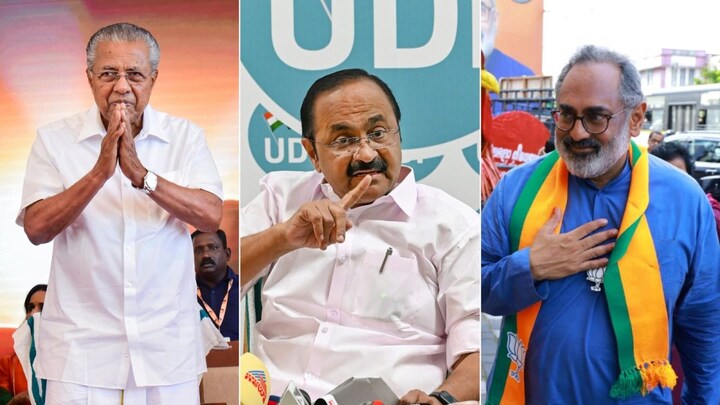
Kerala election outlook: Key battles feature Left Democratic Front versus United Democratic Front with Bharatiya Janata Party pushing in Nemom and leaders such as Pinarayi Vijayan and Ramesh Chennithala in focus
Kerala election outlook: The high‑octane campaign for the Kerala Assembly elections has drawn to a close, establishing a clear framework for a decisive contest. The single‑phase polls will be conducted on a designated voting day, with the counting of votes slated for a later date.
Kerala now finds itself centre stage in a direct confrontation between the incumbent Left Democratic Front (LDF) and the Congress‑led United Democratic Front (UDF). Simultaneously, the Bharatiya Janata Party‑led National Democratic Alliance (NDA) is striving to expand its footprint in selected constituencies, adding an extra dimension to the electoral dynamics.
The following sections profile the star candidates, enumerate their constituencies, and outline the battles that are expected to attract the most attention.
Pinarayi Vijayan — Dharmadam
Dharmadam in Kannur has become synonymous with the political authority of Pinarayi Vijayan. The constituency stands as a bastion of the Communist Party of India (Marxist) (CPI(M)), where Pinarayi Vijayan has represented the seat since the previous term, securing victory with a margin exceeding fifty thousand votes—one of the largest margins recorded in the state.
Pinarayi Vijayan, a former party strongman and the longest‑serving Chief Minister of Kerala in recent memory, structures the campaign around a narrative of effective governance, expansive welfare delivery, and a robust push for infrastructure development.
In Dharmadam, the principal challenger emerges from the Congress‑led United Democratic Front (UDF), a coalition that historically has struggled to make inroads against the entrenched Left presence. The Bharatiya Janata Party (BJP) also fields a candidate, but its influence remains marginal within this constituency.
Ramesh Chennithala — Haripad
Ramesh Chennithala, a senior leader of the Indian National Congress and former Leader of Opposition, contests the election from Haripad—one of the safest seats for the United Democratic Front (UDF). In the previous election, Ramesh Chennithala secured a vote share exceeding forty‑eight percent, winning by a margin of more than thirteen thousand votes.
Renowned for organisational acumen and extensive administrative experience, Ramesh Chennithala stands among the prominent faces projected as a potential Chief Ministerial candidate for the United Democratic Front (UDF).
The Left Democratic Front (LDF) fields a Communist Party of India (Marxist) (CPI) candidate in Haripad, yet the historical voting pattern—firmly tilted toward the Congress—places Ramesh Chennithala as the clear favourite. The Bharatiya Janata Party (BJP) wields limited influence across this coastal belt.
V. D. Satheesan — Paravur
V. D. Satheesan, Leader of Opposition, has built an unshakeable base in Paravur, remaining unbeaten since the early twentieth century. In the previous election, V. D. Satheesan retained the seat with a margin of more than twenty‑one thousand votes.
Seen as the aggressive front of the Congress campaign, V. D. Satheesan positions himself as a key challenger to the ruling Left Democratic Front (LDF). The Communist Party of India (Marxist) (CPI(M)) continues to field a strong candidate against V. D. Satheesan, but Paravur’s consistent pro‑Congress leaning and the personal connect of V. D. Satheesan make the contest considerably challenging for the Left Democratic Front (LDF).
Rajeev Chandrasekhar — Nemom
Nemom holds the distinction of being the most politically significant constituency for the Bharatiya Janata Party (BJP) in Kerala. It delivered the party’s first and only assembly victory in a previous election cycle before reverting to the Left Democratic Front (LDF) in the subsequent election.
Rajeev Chandrasekhar, a technocrat‑turned‑politician and Union minister, represents the Bharatiya Janata Party’s (BJP) high‑profile bet in this arena. The candidacy of Rajeev Chandrasekhar signals the party’s intent to convert Nemom into a sustainable foothold.
The Communist Party of India (Marxist) (CPI(M)) fields a strong candidate to retain the seat, while the United Democratic Front (UDF) also presents a serious contender. This makes Nemom a rare triangular contest in a state that is largely bipolar.
Jose K. Mani — Pala
Jose K. Mani, chief of Kerala Congress (M) and now aligned with the Left Democratic Front (LDF), fights to retain his grip over Pala. The seat has a long history of being held by Kerala Congress (M) under the late K. M. Mani for more than five decades before the United Democratic Front (UDF) candidate Mani C. Kappan secured a victory in a by‑poll.
K. K. Shailaja — Peravoor
K. K. Shailaja, widely respected for her handling of the Nipah outbreak and the COVID‑19 pandemic, stands as one of the most recognisable faces of the Left Democratic Front (LDF). After achieving a massive win from Mattannur in the previous election, K. K. Shailaja has been fielded from Peravoor—traditionally a Congress‑leaning seat.
In Peravoor, K. K. Shailaja faces sitting MLA Sunny Joseph, who narrowly won in the previous election by just over three thousand votes. With the United Democratic Front (UDF) historically dominant but margins shrinking, Peravoor has emerged as one of the most keenly watched contests in the state.
Chandy Oommen — Puthuppally
Puthuppally transcends the ordinary definition of a constituency; it is a legacy seat of the Congress. For more than five decades, the seat was represented by former Chief Minister Oommen Chandy. Chandy Oommen, his son, carried forward that legacy with a resounding win in a recent by‑poll, securing a margin of over thirty‑five thousand votes.
As a first‑time Member of Legislative Assembly with growing political visibility, Chandy Oommen now faces the challenge of defending this emotional stronghold. The Communist Party of India (Marxist) (CPI(M)) stands once again as the principal challenger, yet the deep‑rooted loyalty of the electorate to the Congress makes the contest a difficult one for the Left Democratic Front (LDF).