R Vaishali Surpasses Divya Deshmukh to Lead Women’s Candidates as Sindarov Stands Firm at the Top of the Open Field
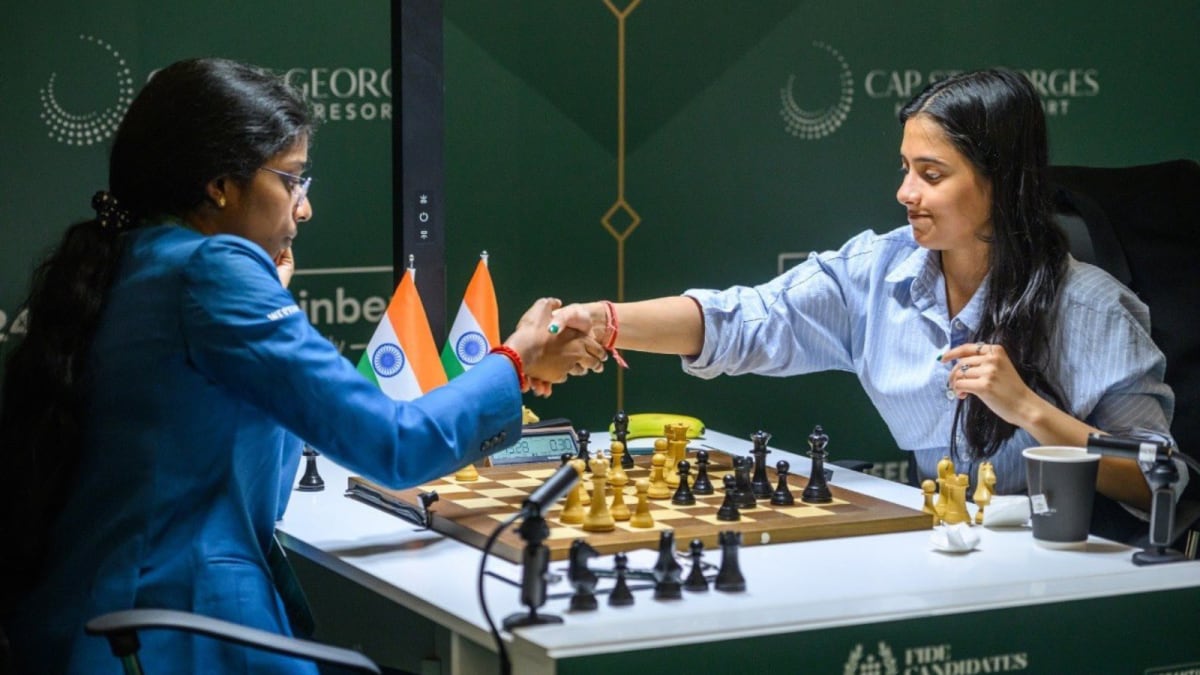
R Vaishali joins Jiner Zhu in women’s Candidates lead on 5.5 points, Anna Muzychuk trails by half, in open Javoklir Sindarov leads on 7 with Anish Giri chasing on 5.5.
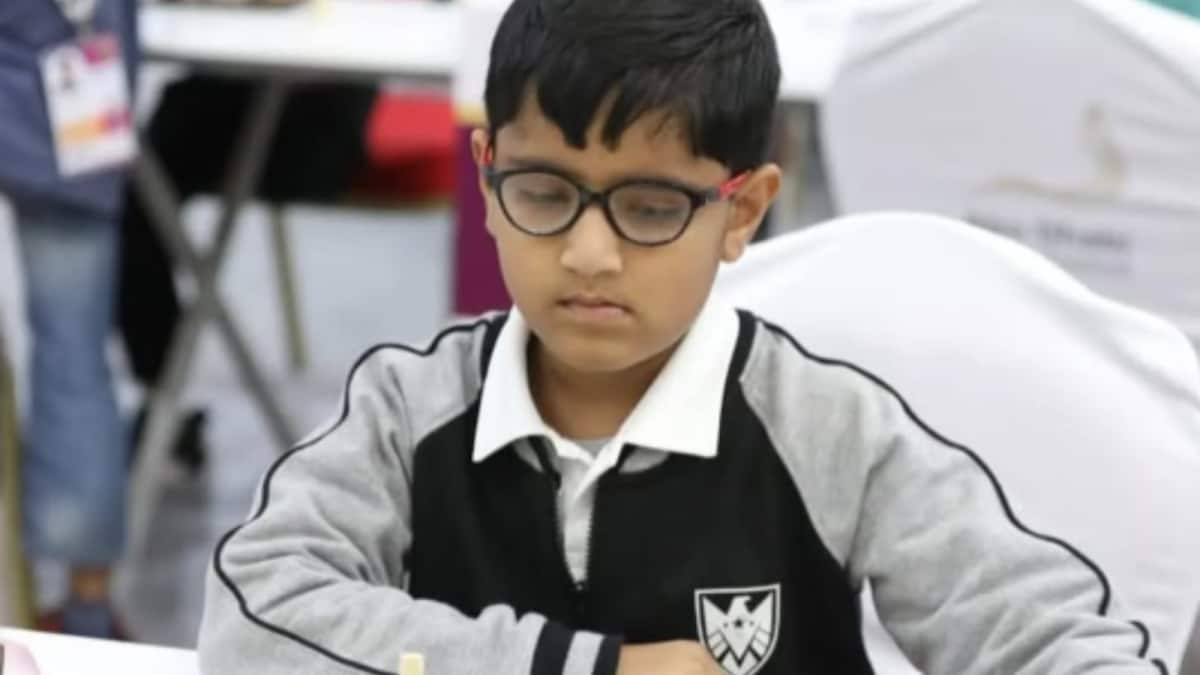
R Vaishali kept Indian hopes alive by defeating compatriot Divya Deshmukh in the ninth round of the women’s Candidates Chess Tournament here on Wednesday.
After what could best be described as a sedate start, R Vaishali has been pushing hard for a win in every game, and this victory keeps R Vaishali in the lead alongside Jiner Zhu of China on 5.5 points out of a possible eight.
With five more rounds to go in the women’s competition, early leader Anna Muzychuk is in close pursuit of the two leaders, just half a point behind, while Divya Deshmukh, Kateryna Lagno of Ukraine and Bibisara Assaubayeva are not far adrift.
The one player out of contention is former women’s world champion Zhongyi Tan, who is still looking for the winning touch.
Poll For You
Will R Vaishali maintain her lead and win the women’s Candidates Chess Tournament?
- AShe will win the tournament
1
- BShe will finish in the top three
0
- CShe will drop out of the top three
0
- DShe will not finish in the top five
0
1
0
0
0
Javoklir Sindarov Still Leads
In the open section, Anish Giri almost ended the hopes of pre‑event favourite Fabiano Caruana of the United States, scoring a brilliant win yet again.
Leader Javoklir Sindarov continued a catch‑me‑if‑you‑can approach with the followers as he took another hard‑fought draw, this time against Matthias Bluebaum of Germany.
As things stand in the open section, Javoklir Sindarov has seven points from nine games and is followed only by Anish Giri of Holland, who has reinvented himself to reach 5.5 points.
It remains to be seen if Anish Giri can catch up with Javoklir Sindarov, but the Uzbek has three white games out of the remaining five.
R Praggnanandhaa tried to prove a point against Wei Yi of China, but the Indian clearly spoiled a much better position in the middlegame. The game eventually ended in a draw as the Indian chess GM is tied fourth.
Candidates 2026 – Results Round 9
Open: R Praggnanandhaa (IND, 4) drew with Wei Yi (CHN, 3.5); Anish Giri (NED, 5.5) beat Fabiano Caruana (USA, 4.5); Javoklir Sindarov (UZB, 7) drew with Matthias Bluebaum (GER, 4); Hikaru Nakamura (USA, 4) drew with Andrey Esipenko (RUS, 3).
Women: R Vaishali (IND, 5.5) beat Divya Deshmukh (IND, 4.5); Jiner Zhu (CHN, 5.5) beat Kateryna Lagno (RUS, 4.5); Aleksandra Goryachkina (RUS, 4) drew with Bibisara Assaubayeva (KAZ, 4); Anna Muzychuk (UKR, 5) drew with Zhongyi Tan (CHN, 3).
(With inputs from Agencies)
Deeper Look at the Women’s Race
The joint lead of R Vaishali and Jiner Zhu at 5½ points illustrates a tightly contested battle for the very top of the women’s field. Both players have demonstrated a blend of strategic patience and tactical sharpness, converting chances into points while avoiding unnecessary risks.
R Vaishali’s win over Divya Deshmukh was particularly significant because it came in a direct encounter between two compatriots. By securing a full point, R Vaishali not only widened the gap over Divya Deshmukh but also sent a clear signal that the Indian contingent remains a force to be reckoned with.
Jiner Zhu, meanwhile, has maintained a steady tempo against the opposition. The victory over Kateryna Lagno, a former world championship challenger, underscores Jiner Zhu’s readiness to take on the most experienced players without hesitation.
Anna Muzychuk, the early tournament leader, now finds herself half a point behind the co‑leaders. The narrow margin indicates that a single win or draw in the remaining rounds could easily shift the leaderboard. Anna Muzychuk’s draw against Zhongyi Tan showed resilience, yet the result also highlights the fine margins separating the top four.
Divya Deshmukh, Kateryna Lagno and Bibisara Assaubayeva remain within striking distance. Their scores, only a point or two away from the leaders, mean that any slip from the current front‑runners could produce a dramatic reshuffling of positions.
Zhongyi Tan, despite a distinguished career that includes a former world championship title, has struggled to find the winning momentum needed this tournament. The draw against Anna Muzychuk is a reminder that even former champions can face challenging phases in a competitive field.
Open Section: The Uzbek Surge
Javoklir Sindarov’s seven points from nine rounds place the young Uzbek firmly at the summit of the open section. His ability to hold his own with white pieces in three of the final five rounds offers a distinct strategic advantage as the tournament progresses.
Anish Giri’s resurgence, highlighted by the win over Fabiano Caruana, has re‑energized his campaign. The Dutch grandmaster’s current tally of 5½ points reflects a series of hard‑earned results, and his performance against top‑class opposition shows a readiness to challenge Javoklir Sindarov directly.
The clash between Anish Giri and Javoklir Sindarov has yet to occur, but the points gap suggests a potential showdown that could decide the ultimate champion. If Anish Giri continues to accumulate points at his present pace, the race could tighten dramatically in the closing rounds.
R Praggnanandhaa’s encounter with Wei Yi ended in a draw after a middlegame misstep. The Indian prodigy’s ability to secure a draw against a strong Chinese opponent keeps him in the competitive mix, especially as he shares fourth place on four points.
Matthias Bluebaum’s draw with Javoklir Sindarov illustrates the Uzbek’s capacity to convert difficult positions into half‑points, a skill that will prove essential when facing the remaining white‑piece rounds.
Hikaru Nakamura’s draw with Andrey Esipenko further demonstrates the depth of talent in the open field. Both players are seasoned competitors, and their result adds an extra layer of complexity to the leaders’ upcoming confrontations.
Strategic Outlook for the Remaining Rounds
With five rounds left in each competition, the pressure intensifies for every participant. In the women’s section, the decisive factor will likely be which of the co‑leaders can maintain consistency while capitalising on the inevitable errors of their rivals.
R Vaishali’s aggressive style, combined with a strong defensive foundation, positions her well to extract maximum points against lower‑scoring opponents. Jiner Zhu, on the other hand, may rely on solid positional play to preserve her current standing.
Anna Muzychuk’s experience in high‑stakes matches could prove crucial. A single win in the remaining rounds would elevate her back to the joint‑lead, while a loss could see her slip further down the table.
In the open section, Javoklir Sindarov’s three white games provide substantial opportunities for decisive victories. His youthful vigor and deep preparation should enable him to press for wins, especially against opponents who may be forced to play with the black pieces.
Anish Giri’s recent form suggests that he can still mount a comeback. By converting at least two of his remaining white games into wins, he could narrow the gap significantly. However, the difficulty of the tasks ahead should not be underestimated.
The remaining competitors—R Praggnanandhaa, Hikaru Nakamura, Matthias Bluebaum, Andrey Esipenko, and others—remain capable of influencing the outcome by delivering upsets or drawing key games that affect the leaders’ standings.