Amit Shah attacks TMC in West Bengal rally, says countdown to end of syndicate rule has begun, promises better security, respect for women and potato trade boost if BJP wins
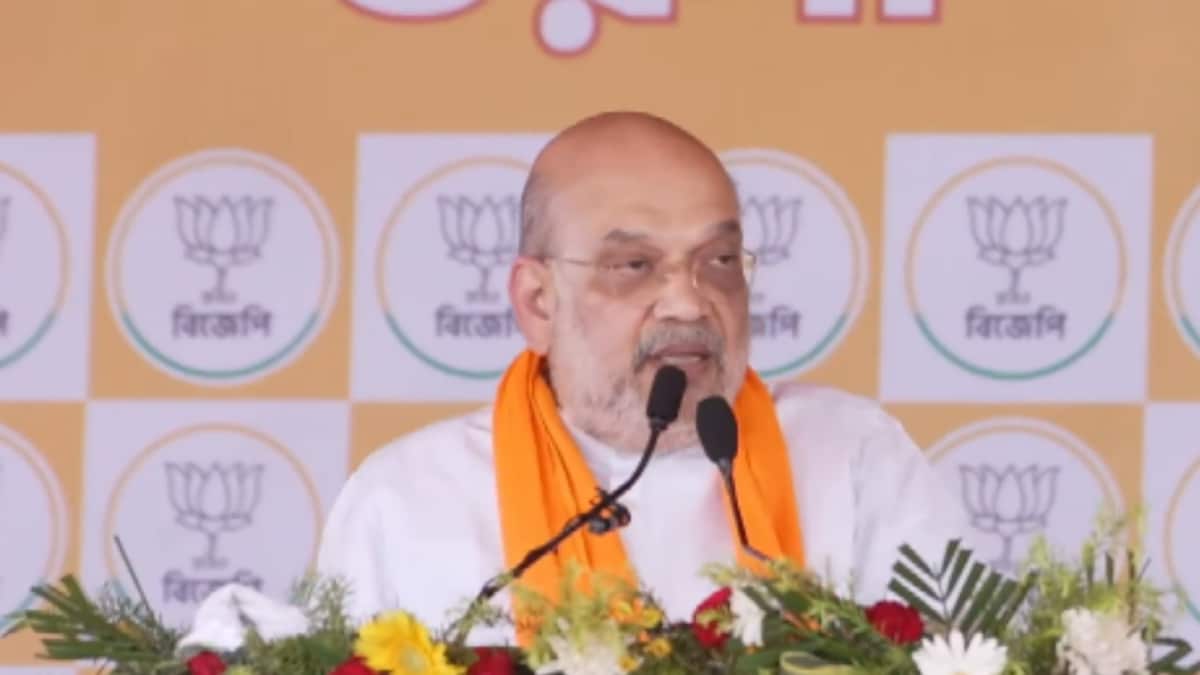
Launching a scathing attack on TMC, the Union Home Minister Amit Shah, while addressing a massive election rally in West Bengal’s Onda, Bankura, said the countdown to the end of TMC’s ‘syndicate rule’ has begun.
“I request you all to bring the BJP to power in Bengal, and then we will question each and every syndicate in the state that has exploited the innocent people of Bengal and action will be taken," Amit Shah said.
TMC के ‘सिंडिकेट राज’ की उलटी गिनती शुरू हो गई है। पश्चिम बंगाल के ओंडा जनसभा से लाइव…তৃণমূলের ‘সিন্ডিকেট রাজ’-এর শেষের কাউন্টডাউন 시작 হয়ে গেছে। পশ্চিমবঙ্গের ওন্দা জনসভা থেকে সরাসরি সম্প্রচার…#BhoyNoyBhorosa https://t.co/qpr328OWsl
— Amit Shah (@AmitShah)
“I promise to the people of Bengal and Vishnupur that the day BJP’s chief minister takes the oath, Bengal’s potatoes, which have a large market, will be sold to Orissa and other neighbouring states; it will bring revenue to the state," Amit Shah said.
“Mamata Banerjee has failed to provide safety and security to the people of the state. Under her rule women are not respected," Amit Shah asserted.
“Whoever has disrespected the women of the state, BJP will take action against each and every person if BJP is voted to power," Amit Shah said.
“The government of West Bengal has forced nearly 7000 industries to go out of Bengal. Mamata Banerjee did not allow them to start business in the state. This has resulted in poverty," Amit Shah said, adding, “Once the BJP government comes to power, we will bring new industries and end unemployment in the state."
My Experience at the Onda Rally
Honestly, standing there in Onda, Bankura, I could feel the heat not just from the sun but from the sheer volume of voices. People were waving tricolour flags, chanting "BJP ke saath, Badla avashyak" and cheering whenever Amit Shah stepped onto the stage. I was there because my cousin, who works in a small potato trading business in Vishnupur, convinced me that this rally could change his fortunes. He keeps telling me that the potato market there is barely surviving, and a promise of better trade with Orissa sounds like a lifesaver.
There were also many women with placards that read "Suraksha ki zaroorat hai" and "Mamata Banerjee ke khilaf hum khade hain". I noticed a few elderly ladies holding baby carriers, and they seemed both hopeful and skeptical. You know, in most cases, people in villages like Bankura are used to hearing big promises during elections, but they also know that reality can be a harsh teacher.
Even the security arrangements felt a bit chaotic. There were police barricades, but a few volunteers from local youth groups were also helping maintain order. I remember a young man from my neighbourhood, Ravi, shouting that if the BJP wins, his family's textile unit might get another chance—he had heard Amit Shah mention that about 7,000 industries leaving the state. That line stuck with me because it’s a number that’s been repeated countless times in the media.
Overall, the atmosphere was a mix of energy, anxiety and a little bit of excitement, something you often experience at big political gatherings in India.
Why Potatoes Became a Central Theme
Now, let’s talk about potatoes—yes, the humble spud that appears on our dinner tables almost daily. Amit Shah’s promise to boost the potato trade might sound quirky, but it has real weight for many in West Bengal. In districts like Vishnupur, potato farmers depend on the crop for the bulk of their income. The state already supplies a large portion of potatoes to neighbouring Odisha (the name "Orissa" is often used in older references), but the market rates have been volatile.
When Amit Shah said, “Bengal’s potatoes, which have a large market, will be sold to Orissa and other neighbouring states; it will bring revenue to the state," he was essentially promising a stable market and better prices for farmers. I have a friend whose uncle sells potatoes from his small stall in Bankura every morning. He told me that the price of a kilogram of potatoes has fluctuated between 10 and 15 rupees in the last few months, making planning a real challenge. A promise of a guaranteed buyer like Odisha can be a huge relief.
But the promise also carries some political calculus. By highlighting a common agricultural commodity, Amit Shah aimed to connect with the everyday farmer, making the larger political narrative feel personal. It's a classic move: link your party to a tangible benefit that people can see on the ground.
From my perspective, the promise felt both appealing and a little vague. I kept asking myself, "Will the central government actually intervene in the market? Can they really ensure better prices for every potato farmer?" But honestly, at a rally, the crowd doesn’t need the details; they need the feeling that someone cares about their livelihood.
Women’s Safety and Respect – A Repeated Theme
Another big chunk of Amit Shah’s speech was about women’s safety. He said, “Mamata Banerjee has failed to provide safety and security to the people of the state. Under her rule women are not respected," and added that the BJP would act against anyone who disrespects women. This resonated strongly because, in West Bengal, there have been several high‑profile cases that have made families uneasy.
For example, my neighbour Priya, a school teacher in Bankura, told me that she often hears stories of harassment on her commute to work. She told me that any assurance about safety would make a big difference for her and many other women who travel alone on buses or trains. When Amit Shah said, “Whoever has disrespected the women of the state, BJP will take action…” it felt like a direct answer to those concerns.
In daily life, though, safety is a complex issue. You can have a strong political statement, but on the ground you need effective policing, better street lighting, and quick response services. I remember walking home from a market stall late in the evening when a group of men were shouting near the road. A local constable arrived quickly, and the situation diffused. That made me think: promises are good, but the implementation is where the real challenge lies.
Still, the rally crowd cheered loudly whenever Amit Shah mentioned women’s respect. The chant “Suraksha ke bina koi bhi kaam nahi” echoed across the field. It tells you how much that issue matters to the people listening.
Industry Exodus and Unemployment – The Economic Angle
Amit Shah also talked about industry loss. He claimed the West Bengal government forced nearly 7,000 industries to leave the state. That number is frequently quoted in opposition rallies, and it fuels a narrative that the current administration is stifling business.
My cousin’s friend, Arvind, runs a small garment unit in Vishnupur. He told me that when the state government tightened certain regulations a few years back, it became harder for his factory to operate. According to him, many larger factories shut down or moved to other states like Odisha and Jharkhand, where they felt the environment was friendlier. This left a lot of skilled workers without jobs.
When Amit Shah promised, “Once the BJP government comes to power, we will bring new industries and end unemployment in the state," it hit home for people like Arvind. However, the promise is broad. It does not specify what kind of industries, what incentives, or how many jobs will actually be created.
In most cases, bringing new industries requires a combination of policy reforms, infrastructure development, and skilled workforce training. During my visit to a small industrial area near Bankura, I saw many empty factory units with rusted machinery. The silence there spoke louder than any political speech. Yet the crowd at the rally seemed to believe that a change in government would automatically revive these places.
Even though the speech was full of big claims, it painted a picture of hope for many families that have been struggling with job loss for years.
Personal Observations on the Rally’s Impact
From my spot in the crowd, I could see a mixture of hope, doubt and even a pinch of cynicism. Some people were waving mobile phones, recording the speech, maybe to share on social media later. Others were simply listening, eyes glistening with expectation. I talked to a few vendors who had set up stalls near the stage, selling tea and samosas. They told me that they sell more during election rallies because the crowd needs snacks, and also because political events bring in extra cash.
When Amit Shah said, “I request you all to bring the BJP to power in Bengal, and then we will question each and every syndicate in the state…,” I could sense a shift in tone among the listeners. Some started chanting “BJP ki jeet,” and a few started shouting “Bhoy Noy Bhorosa.” It was as if the crowd was craving assurance that the current leadership was not listening to them.
Interestingly, there were also some clean‑energy campaign banners behind the stage, promoting solar panels in West Bengal. While not directly mentioned by Amit Shah, it reminded me that these rallies are also platforms for various groups to put their messages out there.
Overall, the experience felt like a microcosm of Indian election season—full of noise, colors, slogans, and a palpable sense that every word spoken could have a real effect on ordinary lives.
What This Means for the Upcoming Election
Looking ahead, Amit Shah’s speech in Onda, Bankura could shape how voters view the BJP’s promise versus the TMC’s record. The chief minister Mamata Banerjee has been fighting the narrative that her government is business hostile. Meanwhile, the BJP is trying to present itself as the party that can bring safety for women, revive the potato trade, and attract lost industries back to West Bengal.
In most cases, elections in India are decided not just by policy but by the perception of who will bring change. Amit Shah’s promise to end the "syndicate rule" taps into a feeling that many people have about corruption and cronyism. By using words like "countdown" and "syndicate," the speech creates a sense of urgency.
For the average voter in West Bengal, especially in semi‑urban and rural areas, the promise of a stable potato market or new factories can be very compelling. The personal stories I heard—like Priya’s safety concerns, Arvind’s industrial struggles, and my cousin’s potato business—underpin those political promises with lived experiences.
However, it’s also clear that statements alone may not be enough. People will be looking for tangible actions once the elections are over. The future of West Bengal’s economy, women’s safety, and industrial revival will depend on how well any new government can translate campaign rhetoric into real policies.
All in all, attending the rally gave me a front‑row seat to the political drama that will soon unfold across West Bengal. Whether the countdown Amit Shah mentions turns into a real transformation or remains just a slogan will be something we’ll all watch closely in the coming months.