Centre Argues Sabarimala’s Deity Attribute Renders Judicial Review Inapplicable
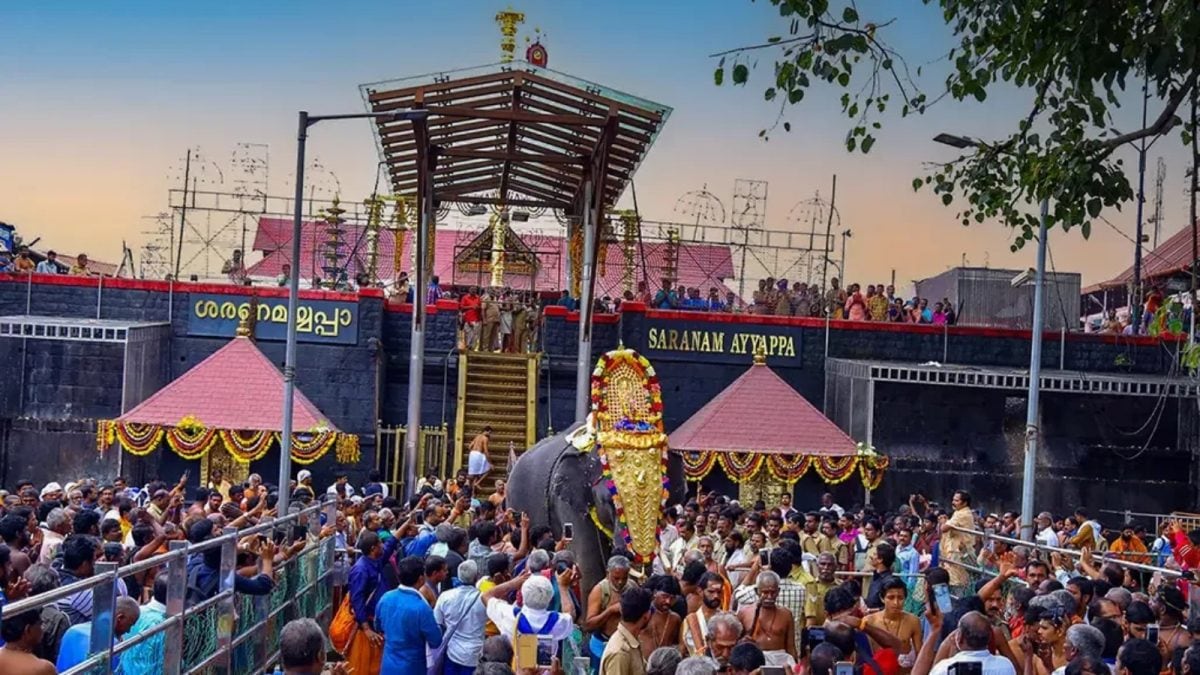
Supreme Court begins hearing Sabarimala review, Centre calls temple restrictions "sui generis", questions applying equality and untouchability claims.
Supreme Court opened deliberations on the long‑standing review petitions concerning entry to Sabarimala temple. The Centre, represented by Solicitor General Tushar Mehta, mounted a defence of the shrine’s intrinsically religious character and challenged the extent to which courts may intervene in matters rooted in faith.
Before a nine‑judge Constitution Bench headed by Chief Justice of India Surya Kant, Solicitor General Tushar Mehta maintained that the core of the Sabarimala controversy lies in an attribute of the deity worshipped at the site, and that such a religious attribute does not lend itself to constitutional adjudication.
“Sabarimala is about an attribute of a deity—how can an attribute be judicially examined?” Solicitor General Tushar Mehta asserted, urging the bench to exercise restraint when confronted with deeply held religious beliefs and practices.
The Constitution Bench, comprising Justices Joymalya Bagchi, B V Nagarathna, R Mahadevan, M M Sundresh, Ahsanuddin Amanullah, Aravind Kumar, A G Masih and Prasanna B Varale, is tasked with probing an array of constitutional questions. Central among these are the scope of religious freedom protected under Articles 25 and 26 of the Constitution, and the degree to which judicial institutions may intrude upon established religious customs.
In the course of argument, Solicitor General Tushar Mehta emphasized that not every religious practice can be judged solely on the basis of individual rights. He contended that denominational traditions merit a degree of respect that precludes automatic classification as violations of personal dignity or bodily autonomy.
“Every denomination practice we have to respect; everything does not relate to dignity or bodily freedom,” Solicitor General Tushar Mehta explained. “If I go to the mazar or the gurudwara and I have covered my head, I cannot say my dignity or right or choice is taken away.”
Drawing parallels with other faith traditions, Solicitor General Tushar Mehta noted that head covering is a customary requirement at Sikh places of worship and at the shrine of Ajmer Sharif. He observed that a new line of jurisprudence acknowledges the diversity of religious expression while maintaining that no caste‑based discrimination is intended within Hindu practice.
Focusing specifically on the restriction at Sabarimala, Solicitor General Tushar Mehta argued that the limitation pertains to a particular age group and is unique to the temple dedicated to Lord Ayyappa. He described the situation as a “sui generis” case, meaning that it possesses distinct characteristics that set it apart from other religious contexts.
Solicitor General Tushar Mehta also raised objections to attempts to equate the Sabarimala restriction with the prohibition against untouchability enumerated in Article 17. He maintained that the age‑based exclusion at Sabarimala does not fall within the ambit of untouchability and therefore should not be analyzed under the framework of Article 17.
“The restriction at Sabarimala is linked to the deity’s specific attribute and the temple’s unique tradition,” Solicitor General Tushar Mehta asserted. “To force the matter into the mold of untouchability under Article 17 would mischaracterize the nature of the practice.”
The Constitution Bench is expected to grapple with the delicate balancing act between protecting individual constitutional rights and preserving religious autonomy. The bench must consider whether the age‑based exclusion, rooted in the theological narrative surrounding Lord Ayyappa, can be reconciled with the constitutional guarantees of equality, non‑discrimination, and freedom of religion.
Arguments presented by the Centre underscore a broader doctrinal debate about the limits of judicial scrutiny when confronted with practices that are intrinsically tied to the identity of a deity. The contention rests on the premise that certain religious attributes are beyond the purview of legal analysis because they emanate from theological doctrines rather than from socially constructed norms.
By invoking the concept of “sui generis,” the Centre seeks to carve out a space where the Constitution Bench may recognize the distinctive nature of the Sabarimala tradition while still upholding the broader constitutional architecture.
Legal scholars observing the proceedings note that the outcome of the hearing will have far‑reaching implications for the jurisprudence of religious freedom in the country. A decision that affirms the Centre’s position could set a precedent for limiting judicial intervention in other faith‑based practices that are framed as essential attributes of divine beings.
Conversely, a ruling that subjects the Sabarimala restriction to rigorous constitutional scrutiny could expand the scope of Articles 25 and 26, reinforcing the principle that no religious practice may infringe upon fundamental rights without a compelling justification.
The Constitution Bench, guided by Chief Justice of India Surya Kant, will therefore need to weigh doctrinal fidelity against the imperatives of equality and non‑discrimination, all the while navigating the complex terrain of faith‑based customs.
In closing, Solicitor General Tushar Mehta reiterated the Centre’s stance that the age‑based restriction at Sabarimala is an expression of a specific religious belief concerning Lord Ayyappa’s celibate nature. He urged the Constitution Bench to recognize that such belief, anchored in the deity’s attribute, cannot be dissected through the lens of contemporary constitutional doctrine without risking intrusion into the core of religious identity.
The hearing is set to continue, with further arguments expected to delve deeper into the interplay between constitutional guarantees and the autonomy of religious institutions. The Constitution Bench’s forthcoming judgment will shape the contours of religious freedom, equality, and the permissible reach of judicial oversight in matters of faith.