‘He Fled To Hyderabad’: Assam Chief Minister Himanta Biswa Sarma Claims Congress Operative Pawan Khera Absconded Amid Passport Controversy Involving Riniki Bhuyan Sharma
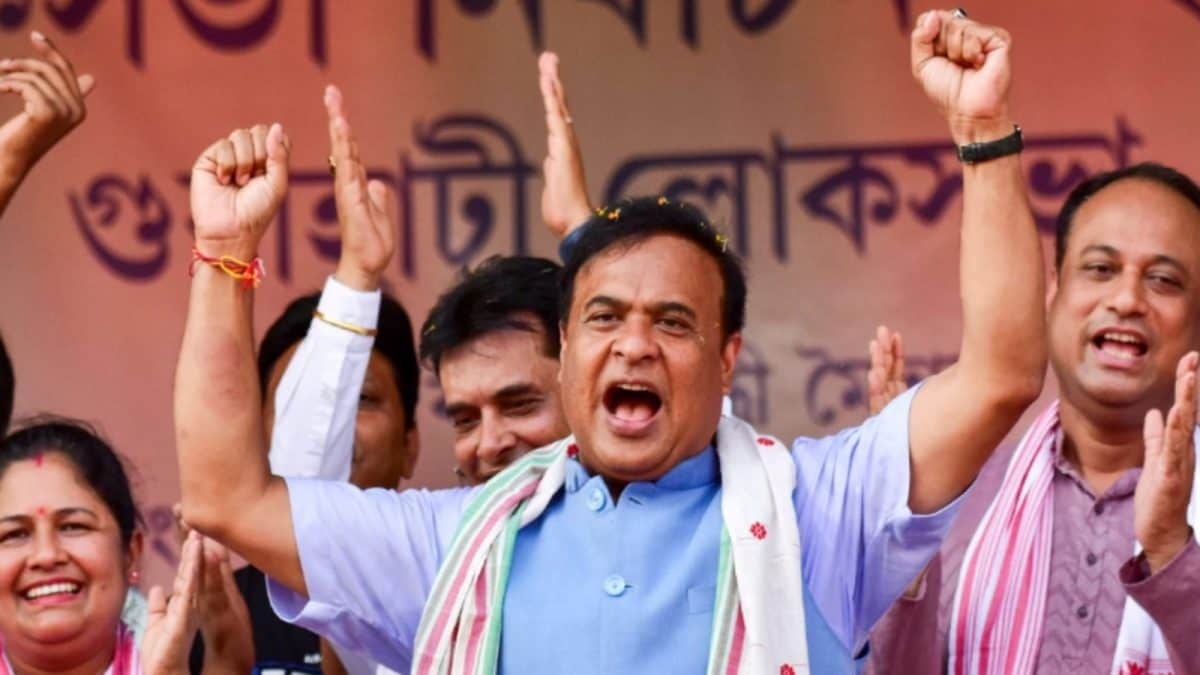
Assam Chief Minister Himanta Biswa Sarma on Tuesday claimed that Congress media and publicity chief Pawan Khera has fled to Hyderabad. Earlier in the day, teams of Assam Police and Delhi Police arrived at Pawan Khera’s residence in Delhi after an FIR was lodged in connection with the passport controversy involving Riniki Bhuyan Sharma. However, Pawan Khera was not present at the address.
Police Arrival and Search Operation
A four‑member contingent from Assam Police entered the Nizamuddin dwelling identified as Pawan Khera’s residence. The contingent was accompanied by officers from Delhi Police, who provided logistical and operational support. Local law‑enforcement agencies had been alerted in advance and coordinated the entry to ensure procedural compliance.
The Assam Police team established a perimeter around the dwelling and maintained a presence for several hours, waiting for Pawan Khera to appear for questioning. Throughout the interval, the officers conducted a visual sweep of the premises but did not locate Pawan Khera inside any of the rooms.
Assam Chief Minister Himanta Biswa Sarma seized upon the absence of Pawan Khera to launch a pointed criticism, stating, “Till yesterday Pawan Khera was shouting ‘arrest me’—now the police went and Pawan Khera fled to Hyderabad. I will turn Pawan Khera into ‘Pawan Peda.’” The remark captured widespread media attention and sparked a rapid exchange of statements between the two political leaders.
Passport Allegations Spark Political Row
Congress media and publicity chief Pawan Khera publicly alleged that documents indicated Riniki Bhuyan Sharma possessed multiple foreign passports, thereby prompting concerns about potential violations of Indian law, which prohibits dual citizenship. According to Pawan Khera, the documents suggested that Riniki Bhuyan Sharma held passports issued by the United Arab Emirates, Egypt, and Antigua and Barbuda.
Pawan Khera further expanded the scope of the allegations by pointing to property holdings allegedly located in Dubai, as well as corporate assets tied to entities registered in the U.S. state of Wyoming. The claim regarding Dubai property was framed in terms of a specific room number in a hotel, which Pawan Khera presented as evidence of real‑estate ownership abroad.
The central question raised by Pawan Khera centered on Indian citizenship law, which does not permit individuals to hold dual nationality. Pawan Khera asked, “According to Indian law, you cannot hold dual citizenship, so does Riniki Bhuyan Sharma also hold an Indian passport?” The query was intended to highlight an alleged inconsistency in the legal status of Riniki Bhuyan Sharma.
Additional rhetorical questions were directed toward Assam Chief Minister Himanta Biswa Sarma, suggesting a familial link between Assam Chief Minister Himanta Biswa Sarma and central Home Minister Amit Shah. Pawan Khera asked, “Is Himanta Biswa Sarma the adopted son of Amit Shah? And did the country’s Home Minister know that his adopted son’s wife holds three passports?” The insinuations sought to connect the alleged passport irregularities to broader national‑level political dynamics.
Assam Chief Minister Himanta Biswa Sarma’s Counter‑Narrative
Assam Chief Minister Himanta Biswa Sarma responded to the passport allegations by emphasizing that Riniki Bhuyan Sharma had already filed an FIR against Pawan Khera for defamation and the circulation of false information. Assam Chief Minister Himanta Biswa Sarma warned that legal consequences would follow any attempts to manipulate the electoral process through fraudulent documentation.
In a forceful statement, Assam Chief Minister Himanta Biswa Sarma declared, “When you raise an issue with fraudulent documents, it attracts sections 420 and 468 of the Indian Penal Code. When such documents are used to influence an election, the punishment is life imprisonment.” The remarks underscored the seriousness with which Assam Chief Minister Himanta Biswa Sarma regarded the allegations.
Assam Chief Minister Himanta Biswa Sarma also asserted that the material employed by Congress in the press conference had been sourced from external actors. “During our research, we found that the entire material of the press conference was supplied by a Pakistani social media group,” Assam Chief Minister Himanta Biswa Sarma said, adding that Pakistan‑based media channels had recently conducted multiple discussions concerning the Assam elections.
The statement implied that the passport controversy was part of a coordinated disinformation campaign aimed at influencing voter sentiment in Assam, thereby positioning the allegations as an external interference rather than an internal investigative matter.
Congress Party’s Reaction to Police Action
Congress leader Supriya Shrinate publicly criticized Assam Chief Minister Himanta Biswa Sarma for the manner in which the investigation was being handled. Supriya Shrinate accused Assam Chief Minister Himanta Biswa Sarma of resorting to intimidation and name‑calling instead of addressing the substantive charges raised by Pawan Khera.
Supriya Shrinate’s statement read, “You are facing serious charges of corruption, Himanta Biswa Sarma, and you are clearly rattled. Why don’t you answer the charges levelled by Pawan Khera instead of resorting to name calling and intimidation? Stop your theatrics, because you can no longer hide your corruption.” The remarks were amplified through social media platforms, where the message was shared widely among supporters of the opposition.
The opposition’s narrative framed Assam Chief Minister Himanta Biswa Sarma’s reaction as an attempt to deflect attention from alleged wrongdoing, positioning the passport controversy as a legitimate issue that warranted thorough investigation rather than political theatrics.
Riniki Bhuyan Sharma’s Denial of Allegations
Riniki Bhuyan Sharma categorically rejected the claims that she held multiple foreign passports. In response to inquiries about dual citizenship, Riniki Bhuyan Sharma asserted, “No. How can I have three passports? India is the only country that doesn’t allow dual citizenship.” The statement reaffirmed the legal impossibility of holding more than one passport under Indian law.
When confronted with the allegation that she possessed property in Dubai, Riniki Bhuyan Sharma described the claim as “fake” and suggested that the reference to a hotel room number did not constitute genuine property ownership. “They have given a room number in a hotel. What kind of property is that? If I had property, I would buy a house,” Riniki Bhuyan Sharma explained.
Riniki Bhuyan Sharma also dismissed the entire set of accusations as fabricated, labeling them “AI generated.” The description implied that the alleged evidence was produced by artificial intelligence algorithms rather than authentic documentation, thereby questioning the credibility of the materials presented by Pawan Khera.
Through these statements, Riniki Bhuyan Sharma aimed to dismantle the narrative that suggested any violation of citizenship or property laws, positioning herself as a victim of misinformation.
Broader Political Context and Implications
The passport controversy emerged in the weeks leading up to a crucial state election in Assam, a contest that traditionally pits the ruling party, led by Assam Chief Minister Himanta Biswa Sarma, against the opposition, primarily represented by the Congress party. Within this electoral framework, allegations relating to foreign passports and overseas assets have the potential to sway public opinion, particularly among voters concerned about national security and the integrity of public officials.
Assam Chief Minister Himanta Biswa Sarma’s emphasis on the involvement of a Pakistani social media group was intended to frame the controversy as part of a broader external interference strategy. By linking the allegations to a foreign source, Assam Chief Minister Himanta Biswa Sarma sought to portray the passport row as an attempt by hostile actors to undermine the democratic process.
Conversely, Congress leader Pawan Khera positioned the issue as an internal matter of accountability, insisting that a public servant’s spouse must be subject to the same legal standards as any other citizen. The demand for transparency regarding dual nationality and overseas assets was presented as a legitimate concern for the electorate.
The reaction from Congress leader Supriya Shrinate reinforced the opposition’s stance that the ruling party was attempting to conceal wrongdoing through intimidation tactics. By accusing Assam Chief Minister Himanta Biswa Sarma of “theatrics,” Supriya Shrinate highlighted a perceived pattern of deflection and denial within the ruling establishment.
The interplay of accusations, counter‑accusations, and legal maneuvers reflects a classic pattern of political conflict during election cycles, wherein opponents leverage allegations of corruption and foreign influence to question the ethical standing of their rivals.
Both Assam Chief Minister Himanta Biswa Sarma and Riniki Bhuyan Sharma have repeatedly underscored that the allegations are based on fabricated documentation, emphasizing the legal prohibition against holding dual citizenship in India. Their consistent denial serves to maintain the narrative that no legal breach has occurred.
Meanwhile, the operational details of the police visit—such as the joint involvement of Assam Police and Delhi Police, the advance coordination with local authorities, and the explicit statement that Pawan Khera was not present at his residence—illustrate the procedural rigor applied in the investigation. The subsequent claim that Pawan Khera fled to Hyderabad adds a layer of complexity, suggesting that the suspect may have evaded law‑enforcement scrutiny.
Overall, the episode underscores how allegations of foreign passports and overseas assets can become potent political weapons, especially in a climate where national security concerns intersect with electoral competition.