When Jawaharlal Nehru’s Iconic “Tryst With Destiny” Is Flagged as AI, What Hope Remains for Human Writers?
AI content detectors are increasingly misclassifying genuine human text, from historic speeches to foundational documents. Even Jawaharlal Nehru’s celebrated address is not exempt.
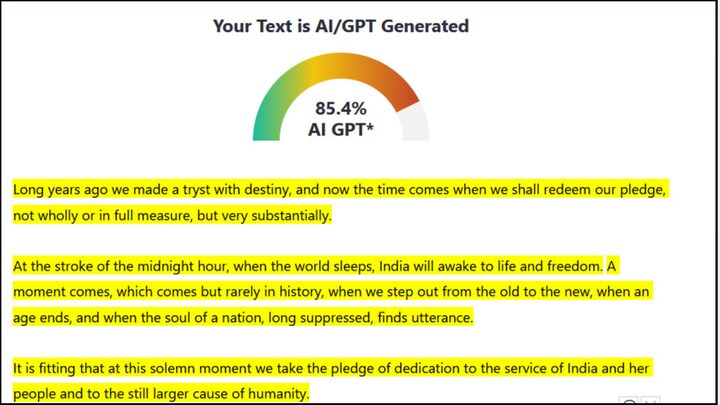
Content detectors that have mushroomed as rapidly as generative AI tools are increasingly misfiring. Not even Jawaharlal Nehru is immune!
The writing and publishing community on LinkedIn is currently mourning the loss of punctuation marks like the em dash, and formatting conventions like bullet points, long valued for their ability to improve readability. The grievance stems from genuine frustration: even authentic human writing that employs these devices is increasingly being flagged as AI‑generated.
The culprit? A host of AI detectors that have multiplied almost as rapidly as generative AI tools such as ChatGPT, whose adoption they were built to monitor.
AI detectors are designed to analyse linguistic patterns and assess whether a given piece of text was likely produced by a machine or a human. Writing that flows evenly, maintains consistent tone, and lacks the irregular rhythms of organic thought is especially vulnerable to suspicion.
These AI detectors are trained on large datasets of both human‑written and AI‑generated content, programmed to identify subtle stylistic tropes like repetitive phrases, uniform sentence structure, and grammatical precision.
What many end‑users of such detectors, such as recruiters, editors, and distribution platforms, tend to overlook is that such tools measure probability, not certainty. Most are transparent about this limitation in their disclaimers. Yet once an AI‑likelihood score appears on screen, even an ambiguous percentage carries enough suggestive weight to cast doubt on a writer’s sincere and original effort.
This anxiety is already reshaping how writers work. Many are abandoning the em dash and the listicle, both of which have featured in literary and journalistic writing across genres for generations, not out of choice, but out of self‑protective instinct.
The stakes of this misclassification are perhaps best illustrated by a striking example: ZeroGPT, one of the most popular content detectors online, flags Jawaharlal Nehru’s Tryst with Destiny speech, delivered on the eve of India’s independence, as AI‑generated. The apparent offence is the speech’s flawless structure and the lucid, deliberate articulation of its ideas.
AI detectors have even also labelled the United States Constitution as 100% AI‑written.
This kind of quantifiable yet devoid of nuance content classification is deepening an already fraught debate about AI‑generated writing flooding the internet.
And the consequences extend well beyond bruised egos. Universities and institutions worldwide are deploying these tools to review student assignments and examinations, often with disastrous consequences.
At Texas A&M University, a professor screened final exam papers using AI detection tools, resulting in multiple students failing the course. Upon appeal, several students were able to prove using writing portfolios, internet histories and notes that their work was original, but not before fracturing relationships with faculty.
More recently, a French‑born Yale EMBA student filed a lawsuit alleging she was falsely accused of using AI on a final exam and coerced into a false confession. She alleged discrimination against her as a non‑native English speaker, resulting in a year‑long suspension and a failing grade.
This bias against non‑native English speakers has even been documented. A study by researchers at Stanford found that AI detectors misclassified over 61% of essays written by non‑native English speakers as AI‑generated, but declared near‑perfect accuracy on essays by native English speakers.
The reason is structurally unfair: formal grammar, measured sentence construction, and careful word choice — hallmarks of someone writing carefully in a second language — are precisely the patterns these tools are trained to flag as machine‑generated. (PS: You will have to pry the long dash from my cold, dead hands).
Some institutions have drawn the logical conclusion. Vanderbilt University disabled Turnitin’s AI detection tool, noting that at even a 1% false positive rate, roughly 750 of the 75,000 papers it processes annually could be incorrectly flagged.
The reliability problem is compounded by a more troubling one: a blatant conflict of interest built into the business model of several of these platforms. Many content detectors offer — often for a fee, sometimes as a free trial — a feature to humanise flagged text.
The logic is circular: once a piece of writing has been branded AI‑generated, the author is nudged towards using the very same tool to launder it back into acceptability. The irony is that text ‘humanised’ by one detector will, in all likelihood, fail the test of a rival’s algorithm entirely. As one professor put it: “Students now are trying to prove that they’re human, even though they might have never touched AI ever.”
But what’s the alternative? For now, the answers remain elusive — and the writers caught in the crossfire are left to navigate the uncertainty on their own.
Fun fact: this article is 41.5% AI, or 13% AI, or 4.72% AI, or 3.75% AI — depending on which bot you ask!