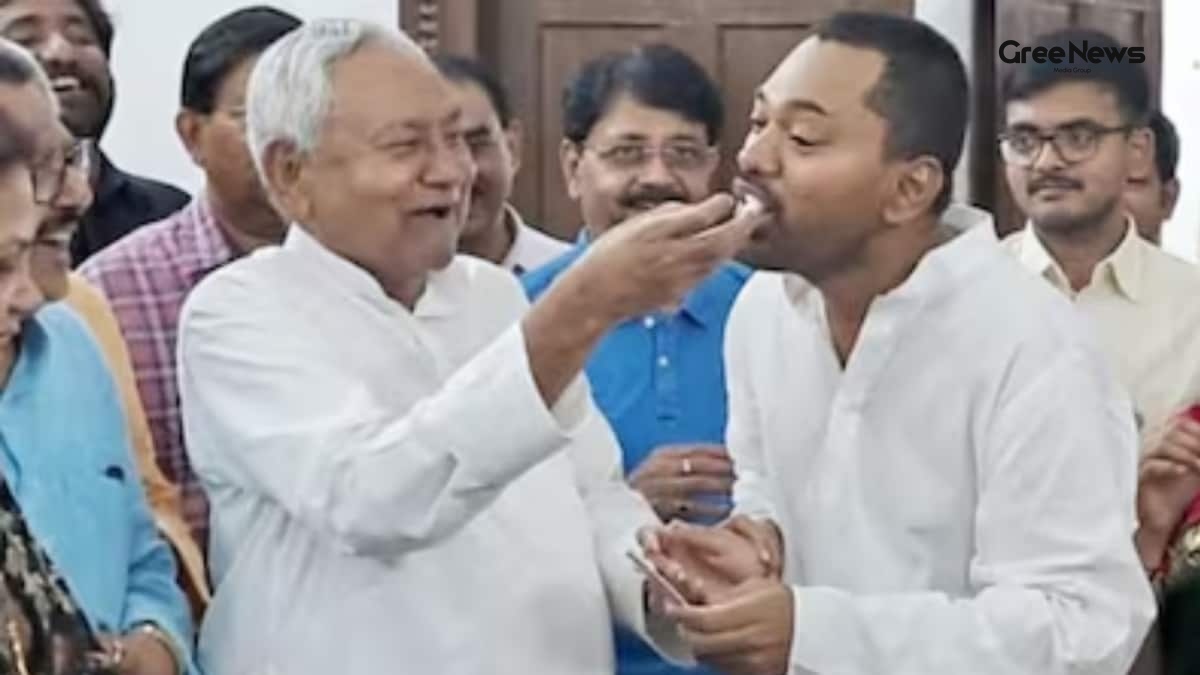
Nishant Kumar Steps Into the Spotlight, Backs Samrat Choudhary
So, the other day I was scrolling through my phone, catching up on the latest news India feeds, when I saw a video of Nishant Kumar, the son of former Bihar Chief Minister Nitish Kumar, standing in front of a modest podium. He looked calm, almost like a friend you meet at a tea stall, and started talking about Samrat Choudhary, the newly sworn‑in Chief Minister of Bihar. He said Samrat was "like my brother" a line that instantly went viral on social media. I was taken aback because the whole political arena has been buzzing with rumours that Nishant might get a Deputy CM ticket. But he made it crystal clear that he isn’t interested in any ministerial portfolio. Instead, he wants to help the party at the grassroots level.
Trust me, when I heard that, I thought, "What a relief!" The speculation had been running like a fever, especially after the spectacular shift when the BJP finally got a chance to lead the state after decades of JD(U) dominance. The fact that Nishant turned down the Deputy CM role and chose to back Samrat made a lot of people especially the party workers feel a bit more settled. It was like that moment when you finally get the last piece of a puzzle, and everything clicks.
Background: The Political Shift in Bihar
To understand why Nishant’s statement is getting so much attention, we need to go back a few months. The Bihar political scene has always been a bit of a roller‑coaster alliances forming and breaking, leaders switching shoes, and a lot of talk about caste equations. The last few weeks have been nothing short of a blockbuster drama. After a bitter fallout between Nitish Kumar’s Janata Dal (United) and the BJP, the BJP decided to go solo into the elections. The outcome? Samrat Choudhary, a veteran BJP leader, became the first BJP Chief Minister of Bihar. That’s a huge piece of breaking news that’s got the entire state buzzing.
What made it even more dramatic was the immediate appointment of two JD(U) leaders as Deputy Chief Ministers. That move, according to many insiders, was designed to keep the NDA alliance balanced a sort of power‑sharing deal that ensures nobody feels left out. While the coalition talks were still fresh, a lot of eyes were on Nitish Kumar’s family, especially his son Nishant, who had recently entered active politics. Everyone wondered: would he be given a high‑profile slot to keep the Kumar legacy alive in the new regime?
When I discussed this with a few friends over chai, they told me that the speculation was almost like a game of “who will get the seat?” each camp throwing out names and rumors. In the midst of that, Nishant’s clear stance not only put an end to the gossip but also gave a glimpse into how the new leadership wants to manage expectations.
What Nishant Said Word for Word
Watching the video, I could hear the genuine tone in Nishant’s voice. He started by congratulating Samrat Choudhary, saying, “Samrat Bhai, you are like my brother, and I have full faith in your leadership.” He then went on to say that the entire team, including JD(U) leaders who are now Deputy Chief Ministers, would work together to serve the people of Bihar. He added, “I have no interest in the Deputy CM post. My focus is on strengthening the party’s work on the ground.”
He also dismissed any notion of internal dissent. “There’s no discontent among us,” he said. That line caught people’s attention because, in Indian politics, rumours of internal rifts spread like wildfire especially when a big ally like JD(U) is part of the coalition.
Honestly, his remarks felt like a friend reassuring you that everything’s fine. The way he used the phrase “like my brother” gave a personal touch that many found relatable it’s like saying a close friend is stepping into a leadership role, and you’re backing them wholeheartedly.
Why This Matters The Implications for Bihar Politics
Now, let’s break down why this matters. First, Nishant’s decision to stay out of the Deputy CM race signals that the BJP is probably serious about keeping the coalition stable. By not pushing for a senior position, he avoids creating any sense of entitlement that could upset the delicate power balance.
Second, his public endorsement of Samrat Choudhary adds a human element to the new government’s image. In a state where politics can often feel distant and elite, a statement like “Samrat is like my brother” makes the leadership feel more approachable, almost like a neighbour who can be trusted.
Third, the focus on grassroots strengthening hints at a strategic shift. The BJP has always been good at organising at the booth level, but Bihar presents unique challenges a mix of rural-urban divide, caste dynamics, and varying development priorities. By emphasising party work on the ground, Nishant is essentially saying, “We’ll build from the bottom up.” That could translate into more visible development programmes, better communication with voters, and perhaps a more robust election strategy for the next cycle.
Lastly, the fact that the JD(U) leaders have already taken up Deputy CM roles underlines that the NDA is trying to operate as a true partnership, not just a dominance‑by‑one scenario. For the ordinary Bihari, this could mean a more coordinated administration something many have been yearning for, especially after years of political turbulence.
Public Reaction From Social Media to Street Corners
When the news broke, the trending news India segment on Twitter lit up. Hashtags like #SamratBrother and #NishantTalks started trending within minutes. I saw a meme where someone had photoshopped Nishant and Samrat together, captioned “Brothers in politics, not just in blood.” It was funny, but it also echoed the genuine sentiment that many were feeling a desire for unity.
On the streets of Patna, I overheard a group of vendors discussing the development promises of the new government. One of them, a mango seller, mentioned that he hopes the new leadership will improve road connectivity because his daily route is a nightmare. Another, a school teacher from a nearby village, said she’s hopeful that education schemes will get a boost now that the BJP is in charge.
From a personal perspective, I felt a strange mix of curiosity and optimism. The whole episode reminded me of the last time a political family stepped back from a high‑profile role it’s rare in Indian politics, where dynastic ambitions often dominate. Seeing Nishant step aside, at least for now, made me think that perhaps there’s a shift towards merit‑based politics, or at least a willingness to let the party’s machinery do the heavy lifting.
What Could Happen Next? A Few Scenarios
Let’s play out a few possible futures. First scenario: Nishant becomes a key organiser for the BJP’s grassroots network. He could travel across districts, connecting with local leaders, addressing grievances, and building a strong cadre base. That would significantly strengthen the BJP’s foothold in districts where JD(U) used to dominate.
Second scenario: Nishant might keep a low profile, focusing on his own political learning, and could be primed for a future contest in the next assembly elections. That would give him time to build credibility among the masses without the pressure of an immediate ministerial role.
Third scenario (the least likely, but still interesting): He could be asked to take on a special advisory role within the government, perhaps focusing on youth affairs or development projects, capitalising on his background and education.
Whatever the path, one thing is certain: his public stance has already set a tone of cooperation and humility. It’s a narrative that fits well with the viral news angle and could be used by both the party and the media to showcase a more inclusive political environment.
Personal Take Why I Care About This Story
Honestly, I’m not a hardcore political analyst. I’m just a regular guy who watches the news while waiting for my auto to arrive. But this story caught me because it shows how politics can sometimes be more human than we think. A son choosing not to chase power, a leader calling his colleague “brother”, and the whole state watching with bated breath that’s the kind of narrative that keeps my interest alive.
Plus, in a country as diverse as India, where each state has its own flavour, Bihar’s political shifts often ripple across the nation. The way the BJP has handled the coalition, the way JD(U) leaders are now Deputy Chief Ministers, and the decision of a prominent political family to stay away from immediate power all these pieces come together like a jigsaw puzzle.
And here’s a little observation: whenever there’s a political transition, I notice a surge in people’s engagement online more comments, shares, and even debates on street corners. That’s the power of India updates that keep us connected. The more we talk about it, the more we understand what’s at stake, and perhaps the better decisions we can make as citizens.
Conclusion A New Chapter for Bihar?
To wrap it up, Nishant Kumar’s decision to back Samrat Choudhary and step back from a Deputy CM berth is more than just a personal choice; it’s a signal to the entire political ecosystem in Bihar. It tells us that the new BJP‑led government is eager to show unity, that JD(U) is still a vital partner, and that the younger generation of politicians might be looking at long‑term party building rather than immediate power grabs.
If you’re following the latest news India headlines, this episode is definitely one to keep an eye on. It could shape the way future alliances are formed, how political families navigate power, and how the people of Bihar experience governance in the coming years. As the story continues to develop, I’ll be waiting for the next update, because in Indian politics, the next twist is always just around the corner.
Stay tuned, and let’s see how this chapter unfolds who knows, maybe the next big India updates will have us all talking about the impact of this decision on the ground, from Patna’s bustling markets to the villages where the first signs of change will be felt.