Warehouse Inferno Sparks Corporate Fallout After Employee's Fury Over Wages Leads to $156 Million Arson
Kimberly‑Clark employee Chamel Abdulkarim, 29, captured his own act of arson on a 1.2 million‑square‑foot Ontario distribution hub, protesting low pay and igniting a blaze valued at $156 million.
Incident Overview
A massive fire erupted inside a 1.2 million‑square‑foot distribution center located near South Hellman Avenue and Merrill Avenue in Ontario. The blaze was officially classified as a six‑alarm fire, prompting a coordinated response from multiple fire agencies, including neighboring jurisdictions. The property, owned and operated by Kimberly‑Clark, houses a broad inventory of consumer tissue products, notably facial tissue and toilet paper, designed to serve an estimated 50 million consumers across the United States.
The fire broke out in the early morning hours, roughly at 12:30 am, when a small group of approximately 20 employees were present inside the facility. The emergency response teams arrived promptly, deploying more than 140 firefighters to battle the conflagration. Despite the scale of the incident, all employees present at the time were reported unharmed, and no injuries were recorded.
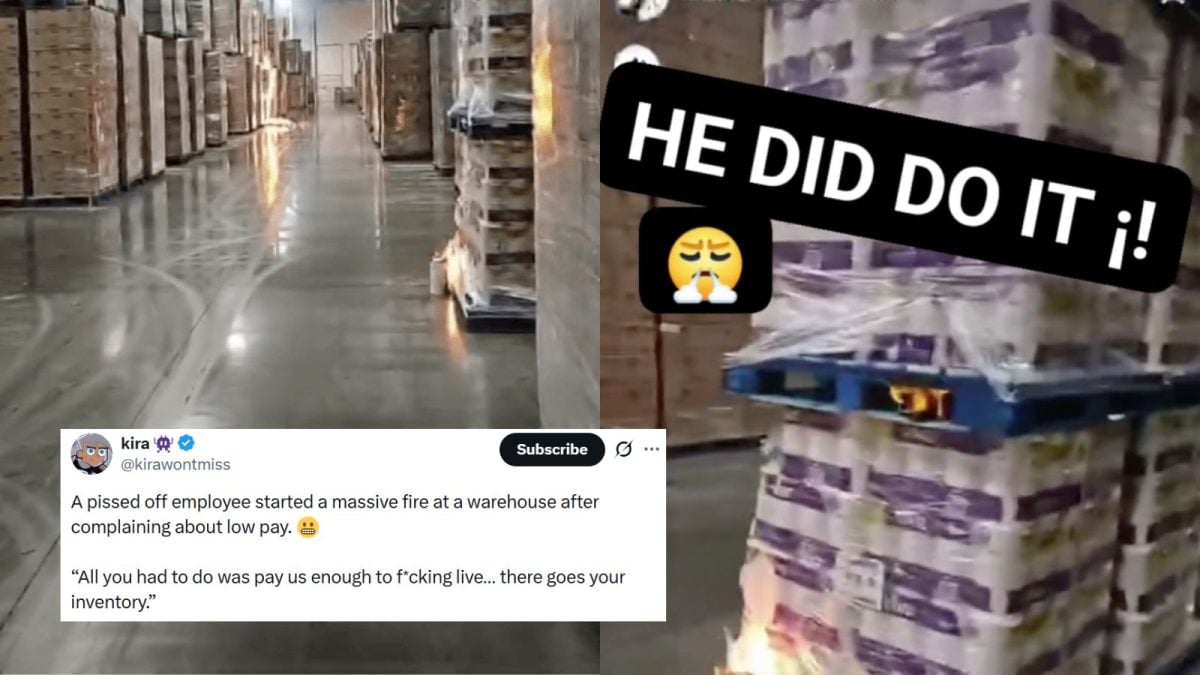
Authorities later identified the cause of the fire as intentional, classifying the event as arson. The investigation uncovered video evidence that appears to show the act of setting the blaze in real time. The footage, disseminated through social media platforms, features Chamel Abdulkarim moving through the warehouse aisles, igniting bundles of product and vocally condemning the compensation practices of Kimberly‑Clark.
Profile of the Suspect
Chamel Abdulkarim, 29, resides in Highland, a community situated within the greater San Bernardino County region. Prior to the incident, Chamel Abdulkarim was employed by Kimberly‑Clark as a warehouse associate, tasked with inventory handling and distribution logistics within the Ontario facility. According to public records, Chamel Abdulkarim now faces two counts of felony arson.
Following the ignition of the blaze, Chamel Abdulkarim was initially reported missing by coworkers. Subsequent law‑enforcement efforts located Chamel Abdulkarim in close proximity to the warehouse while the fire continued to rage. Chamel Abdulkarim was taken into custody without bail and transferred to the West Valley Detention Center in Rancho Cucamonga, where the legal process is ongoing.
Content and Tone of the Video Evidence
The video circulating on Instagram bears the name of Chamel Abdulkarin, and it documents a methodical progression through the aisles of the Ontario warehouse. In the recording, Chamel Abdulkarim pauses at several pallets of toilet paper, applies an ignition source, and allows flames to spread rapidly across the stacked merchandise. The background of the video consistently displays towering rows of product, underscoring the enormity of the inventory stored within the facility.
Throughout the video, an audible voice belonging to Chamel Abdulkarim repeatedly asserts, “All you had to do was pay us enough to live.” The statement is followed by a more explicit remark, “You may not pay us enough to f***ing live, but these b***es dirt cheap,” delivered as the flames intensify. The audio also captures a secondary voice, presumably a colleague using a walkie‑talkie, announcing, “We’ve got a fire in the warehouse,” which highlights the chaotic environment as additional product bundles become aflame.
Law‑enforcement agencies have confirmed the authenticity of the video and are actively analyzing its content to corroborate the timeline of events and to establish a clear chain of causation linking Chamel Abdulkarim to the deliberate ignition.
Firefighting Response and Tactical Operations
As soon as the alarm was raised, the Ontario Fire Department mobilized a substantial contingent of firefighters, rapidly escalating the response to a six‑alarm status. The escalation called for additional resources from neighboring fire districts, including units from San Bernardino County. Fire crews employed a combination of interior attack tactics and external suppression methods to contain the spread of fire across the extensive product aisles.
Deputy Chief Mike Wedell of the Ontario Fire Department commented to media outlets that the fire was swiftly identified as suspicious in nature, prompting an early focus on suspect identification. The rapid categorization of the incident as intentional facilitated the coordination of investigative and tactical teams on the scene.
The combined efforts of more than 140 firefighters, supported by specialized equipment and aerial apparatus, ultimately succeeded in restraining the blaze and preventing further structural collapse. The fire’s containment required extended operational periods, during which fire personnel continuously monitored hot spots and performed overhaul procedures to extinguish residual embers hidden within the product stacks.
Potential Economic Ramifications
Industry analysts have warned that the loss of a facility valued at approximately $156 million may have measurable effects on product availability across the West Coast. The affected warehouse serves a distribution role for a substantial portion of Kimberly‑Clark’s consumer goods, and its temporary removal from the supply chain could contribute to short‑term shortages of essential paper products.
Diana Gomes, a senior analyst with Bloomberg Intelligence, noted that the disruption may impact more than three percent of Kimberly‑Clark’s United States sales volume. Furthermore, the interruption could trigger an increase in transportation expenses as alternate logistics routes are engaged to compensate for the loss of the primary distribution hub.
Following the incident, Kimberly‑Clark’s publicly traded shares experienced a decline of over four percent, reflecting investor concerns over the operational setback and the broader implications for the company’s financial performance.
Legal Proceedings and Custody Status
Chamel Abdulkarim remains in custody at the West Valley Detention Center, pending arraignment on two felony arson charges. The legal process will determine the specific penalties applicable under California law for intentional property destruction of the magnitude observed at the Ontario warehouse.
Law‑enforcement officials have emphasized that the evidence, including the video captured by Chamel Abdulkarim, will play a central role in the prosecution’s case. The investigative team continues to gather supplementary testimony from witnesses present at the facility during the time of ignition, as well as forensic evidence recovered from the scene.
Corporate Response and Market Reaction
Kimberly‑Clark issued a public statement confirming that no employees sustained injuries as a result of the fire. The corporation also affirmed its commitment to cooperating fully with authorities throughout the investigative process.
In addition to the operational challenges, Kimberly‑Clark’s leadership cited the incident as a catalyst for reviewing workplace safety protocols and employee compensation structures. While the company refrained from commenting on the specific grievances expressed by Chamel Abdulkarim, the public acknowledgment underscores an awareness of broader labor concerns within the organization.
The market’s reaction, encapsulated by the noted share price decline, illustrates the immediate financial impact of the incident on stakeholder confidence. Analysts predict that the company’s earnings for the current fiscal period may experience a modest contraction, contingent upon the duration required to restore full operational capacity at the damaged distribution center.