‘I Was Taught To Forget My Own Language’: A Keralite’s Heart‑Wrenching Realisation About School Days Ignites Social Media Debate
His revelation sparked a wave of mixed reaction across social media.
Background of the Confession
School memories are frequently painted with a palette of nostalgia, laughter, and the simple pleasures of childhood. In a striking deviation from the usual celebratory tone, a 30‑year‑old man from Kerala has laid bare a painful truth: despite spending a full twelve years inside the walls of a Kendriya Vidyalaya (KV) school in Kerala, the 30‑year‑old man never acquired fluency in the mother tongue, Malayalam.
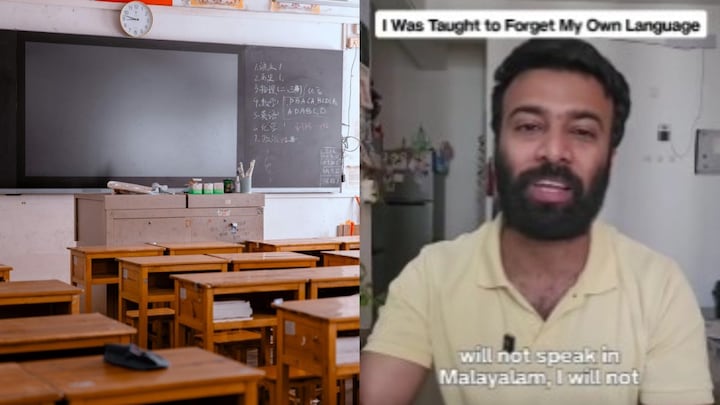
The 30‑year‑old man recounts that any attempt to converse in Malayalam within school premises was met with swift disciplinary action. Those disciplinary measures took the form of repetitive writing tasks that forced the 30‑year‑old man to copy the sentence “I will not speak in Malayalam” hundreds of times. The relentless repetition turned a simple punishment into a deeply internalised belief, leaving the 30‑year‑old man with a lingering sense of shame attached to the very language that belongs to his heritage.
In a candid post on Reddit, the 30‑year‑old man described his educational journey as one devoid of formal instruction in Malayalam. The 30‑year‑old man explains that the curriculum never included reading or writing Malayalam, and that the language was effectively erased from the classroom environment. The 30‑year‑old man’s narrative is supported by a video in which the 30‑year‑old man states, “I studied in a Kendriya Vidyalaya (KV) school in Kerala for all 12 years of my schooling. In all these 12 years, I was never taught my own mother tongue, my own language, Malayalam – not how to read it, not how to write it.”
The Lingering Impact on Literary Access
Now in the thirties, the 30‑year‑old man admits that the gap created by the school system still blocks access to the rich literary heritage of Kerala. The 30‑year‑old man says, “I cannot open a Malayalam book and let it breathe into me. I still haven’t read Madhavikutty or Basheer (Vaikom Muhammad Basheer) or K.R Meera in Malayalam.” The 30‑year‑old man emphasises that the absence of basic comprehension prevents the 30‑year‑old man from feeling the intended weight of sentences crafted by the region’s most celebrated authors.
This cultural distance is illustrated when the 30‑year‑old man overhears fellow Keralites quoting a line of poetry or mentioning a writer; the 30‑year‑old man feels as though an essential part of the conversation is forever out of reach. The 30‑year‑old man likens the situation to standing outside a house that belongs to the 30‑year‑old man but lacking the key to unlock the door.
Further metaphors used by the 30‑year‑old man include hearing the birds of the homeland without knowing their names, watching rain without possessing the word for the earthy scent that follows, and belonging to a place without fully grasping the language that defines its essence. The 30‑year‑old man describes this condition as becoming a foreigner in the very land that gave birth to the 30‑year‑old man’s identity.
Emotional Reverberations and Social Media Reaction
The 30‑year‑old man’s disclosure elicited a cascade of responses across a variety of platforms. Many readers expressed solidarity, sharing personal anecdotes of similar marginalisation of mother‑tongue instruction. Others called for systemic reform, urging educational authorities to integrate regional languages into the core curriculum of central schools.
One Reddit commentator highlighted the redundancy of punitive measures against Malayalam, stating, “The whole system in some schools where they fined or get punished for speaking in Malayalam is the most redundant thing.” Another contributor observed that Kendriya Vidyalaya (KV) schools follow the CBSE system, which implements a “two‑language policy” across India. The commentator noted, “Even my friends who went to KV don’t know Marathi (mother tongue), knew only Hindi and English, whereas I studied in state board, we had second language Marathi compulsory and Hindi optional.”
Other voices shifted the focus toward parental responsibility. A user shared, “My kid goes to a German school. We speak Malayalam at home. She is learning to write Malayalam also. So I would say it is a choice. The parents can choose to teach kids Malayalam if they want wherever they are.” Another participant argued, “It’s the parent’s fault, simply. They could’ve taught him Malayalam at home. I grew up outside India but my parents insisted that I learn Malayalam and encouraged me to read books and newspapers in Malayalam.” The commentator suggested that the parents of the 30‑year‑old man may have believed that proficiency in English conferred social superiority over knowledge of the mother tongue.
In the video that went viral, the 30‑year‑old man captioned the clip with a stark observation: “Some dumb parents are even proud to say that their kids don’t speak mother tongue.” The caption sparked additional debate about the societal pressures that drive families to prioritise English over regional languages.
Broader Implications for Language Policy
The case of the 30‑year‑old man brings to the fore a longstanding tension in Indian education: the balancing act between national‑level curricula and the preservation of linguistic heritage. The 30‑year‑old man’s story illustrates how a policy that favours a uniform language of instruction can inadvertently alienate students from their cultural roots.
While the CBSE’s two‑language framework ostensibly promotes multilingualism, the experience shared by the 30‑year‑old man indicates that implementation can vary dramatically based on school administration and local attitudes. The 30‑year‑old man’s recollection of mandatory writing drills in Hindi or English, paired with the prohibition of Malayalam, underscores the disparity between policy on paper and lived reality within classroom walls.
Critics argue that the approach adopted by some Kendriya Vidyalaya (KV) schools undermines the very purpose of a multilingual education system, which is to equip students with the ability to navigate multiple linguistic landscapes. The 30‑year‑old man’s inability to access Malayalam literature reflects a broader loss of cultural capital that can affect an individual’s sense of belonging and self‑esteem.
Personal Reflections and The Way Forward
In the closing moments of the video, the 30‑year‑old man speaks of envy when witnessing peers effortlessly reading and writing Malayalam. The 30‑year‑old man acknowledges that the educational environment systematically nudged the 30‑year‑old man away from a language that was already an integral part of the 30‑year‑old man’s identity. The 30‑year‑old man describes the process as “slowly, gently, and systematically” erasing the connection to Malayalam.
Looking ahead, many commentators suggest that families can play a pivotal role in re‑establishing the bond with the mother tongue. Initiatives such as reading Malayalam books at home, encouraging conversation in Malayalam, and engaging with local literature are repeatedly mentioned as practical steps to counteract the deficits created by formal schooling.
The dialogue sparked by the 30‑year‑old man’s testimony continues to evolve, inviting educators, policymakers, and parents to reconsider how language instruction shapes cultural identity. By foregrounding the lived experience of the 30‑year‑old man, the conversation underscores the urgent need for a more inclusive approach that recognises the intrinsic value of every child’s linguistic heritage.