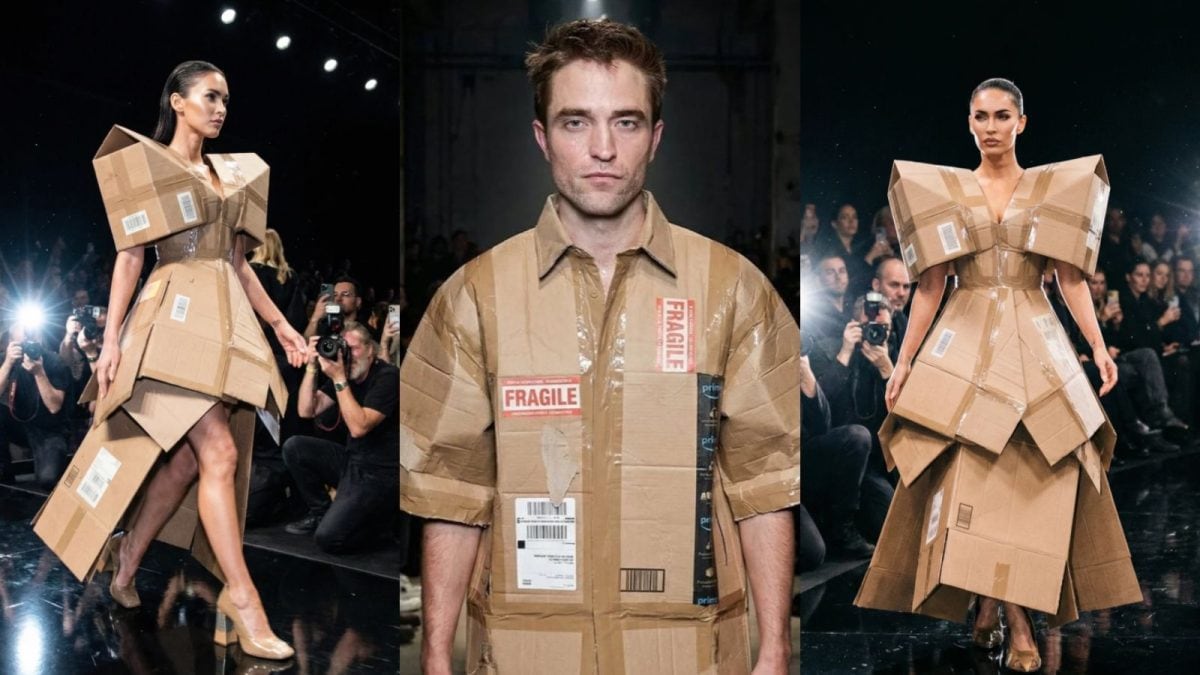
How a cardboard box turned into a supposed Balenciaga dress on the internet
So the other day I was scrolling through my Instagram feed, sipping my chai, and I stumbled upon a picture that instantly reminded me of those bizarre fashion memes we all love. It showed a woman wearing what looked exactly like a plain cardboard shipping box, yet the caption claimed it was a new Balenciaga creation priced at several lakh rupees. My first reaction was: "Is this for real?" because I have seen Balenciaga do weird stuff before, but even then it felt a bit too out there.
What made the post even more mind‑boggling was that the same image was edited to include famous faces like Megan Fox and Robert Pattinson. The idea of these Hollywood stars walking the red carpet in a cardboard‑box dress made the whole thing feel oddly plausible. After all, Balenciaga has a reputation for taking ordinary objects and turning them into runway statements, so my brain didn’t immediately reject the story.
Balenciaga’s love for the weird and the everyday
Balenciaga has never been a brand that shies away from controversy. Over the years the fashion house has shown collections that look like they were made from trash bags, oversized shoes that could double as furniture, and even accessories that resemble everyday hardware. When I think about those runway moments, I remember a show where models strutted in outfits that resembled supermarket plastic bags. The audience laughed, critics wrote think‑pieces, and the internet exploded with memes. That history is why, when I first saw the cardboard‑box dress, a tiny part of me thought Balenciaga might really have done it.
Another example that popped into my mind was the Beijing International Film Festival episode where Zhang Jingyi was spotted carrying a bright yellow plastic bag that turned out to be a designer piece. The whole incident reminded people once again that Balenciaga loves to blur the line between ordinary and luxury. So when the cardboard dress started circulating, many Indians – especially those of us who follow fashion blogs – jumped to the conclusion that Balenciaga had finally taken the cardboard‑box‑as‑couture idea to the next level.
The Instagram account behind the hype
After a while, I decided to dig a little deeper. The original post that sparked the frenzy was not from any official Balenciaga page. Instead, it came from an Instagram account called Sport Simulation, which describes itself as a creator of “celebrity simulations.” The account frequently posts realistic‑looking fashion concepts that do not actually exist. In one of the captions, Sport Simulation wrote something like, “Fashion just took a wild turn. What looks like a simple cardboard shipping box has been transformed into a high‑fashion statement piece, allegedly priced at $8,900 (about Rs 8.24 lakh).”
Seeing that caption, I realized the whole thing was a clever piece of digital art, not an actual Balenciaga collection. Sport Simulation is known for other wild ideas too – like a gown made from toilet rolls or a suit stitched from egg trays. Each time the account releases a new design, it manages to trick a portion of the audience, especially those who scroll quickly without verifying the source.
Why the fake dress fooled so many
There are a few reasons why the cardboard‑box dress seemed believable. First, the visual quality of the image was very high. The lighting, the texture of the cardboard, and the way the ‘dress’ draped on the model all looked professional. Second, the inclusion of Megan Fox and Robert Pattinson added a layer of celebrity endorsement that made the whole story feel authentic. In India, we often see celebrity‑driven fashion trends, so the presence of these stars acted like a shortcut to credibility.
Third, the price tag – Rs 8.24 lakh – matched what we have come to expect from a high‑end label like Balenciaga. It sounded outrageous, yet not impossible. In many Indian households, we hear stories about friends buying a pair of shoes that cost more than a month’s salary, so the price didn’t raise alarms immediately.
Last but not least, the timing was perfect. Social media was already buzzing about sustainable fashion, up‑cycling, and the idea of turning waste into luxury. A cardboard dress fit neatly into that narrative, making it feel like a bold statement rather than a joke.
What Indian netizens said
As soon as the photos started trending, the comment sections lit up with a mix of humor and genuine outrage. One user wrote, “When you take your job at Amazon way too seriously.” Another cheekily replied, “So this is why my Amazon deliveries are always late.” Some people even compared the cardboard dress to the yellow trash bag that Balenciaga once used in a runway piece, saying “First it was a yellow trash bag… now this?”
There were also more serious voices. A few comments urged people to think about the waste of money, saying things like, “Feed the homeless before you waste money on this crap.” Others reminded everyone that it was just a fake, urging caution before believing every viral post that claims to be a new luxury design.
What struck me was how quickly the Indian community turned the conversation into a broader debate about consumerism, the role of influencers, and the responsibility of brands to be clear about what is real and what is not. Many of us shared the post with the caption “Fake or not, it’s a conversation starter,” highlighting how even a fabricated fashion piece can spark meaningful discussion.
Other wild designs from Sport Simulation
To give you a sense of the pattern, here are some other creations that Sport Simulation has posted over the past few months:
- A gown made entirely from toilet paper rolls, complete with a matching headpiece.
- An evening dress crafted from recycled egg trays, featuring a metallic sheen that looked oddly elegant.
- A “broom‑inspired” coat that used actual broom bristles as a decorative element.
- A wedding dress made from layers of yellow grocery bags, which sparked a debate about sustainability versus extravagance.
All of these designs are non‑existent, yet each time they appear, people pause, comment, and share, proving how powerful visual storytelling can be, even when it’s entirely fictional.
My personal take on the whole episode
Honestly, I felt a little embarrassed at first because I had believed the cardboard‑box dress was real for a few hours. But then I realised that the experience taught me a valuable lesson about digital literacy. In India, where internet access is growing rapidly, many users – especially the younger crowd – are still learning to differentiate between genuine brand announcements and clever marketing stunts.
From my side, I started checking the official Balenciaga page whenever I saw a bizarre claim. I also began looking at the account that posted the image. Spotting the “@celebsimulation” handle gave away the clue that this was meant to be a simulation, not an official launch.
Another observation I had was about the power of visual appeal. Even in a country where most people buy clothes from local markets, the allure of a high‑fashion piece can be strong enough to pause and reflect. That’s why I think brands – even unintentionally – should be careful about how they communicate, because a single image can travel across continents in a matter of minutes.
What this tells us about the future of fashion and media
Looking ahead, the cardboard‑box dress episode may be a glimpse into how fashion marketing will evolve. With AI tools getting better at creating photorealistic images, we might see more “virtual collections” that exist only online. Brands could potentially launch digital‑only garments, which consumers can buy for avatars in the metaverse. In that scenario, the line between real and imaginary will blur even further.
For Indian consumers, this means developing a sharper eye for authenticity. It also offers an opportunity for local designers to experiment with unconventional materials – perhaps even real cardboard – in a way that is genuinely sustainable, not just a visual trick.
Until then, I’ll keep scrolling my feed with a bit more caution, remembering that not everything that glitters, or in this case, looks like a cardboard box, is gold. And if you ever see a Balenciaga dress that looks like a school bag, you now know the story behind it.