‘God Is The Greatest Designer’: Viral Moon Clip Delivers Unprecedented Detail of Lunar Surface
A breathtaking clip revealing the lunar surface in "impossible" detail has racked up millions of views
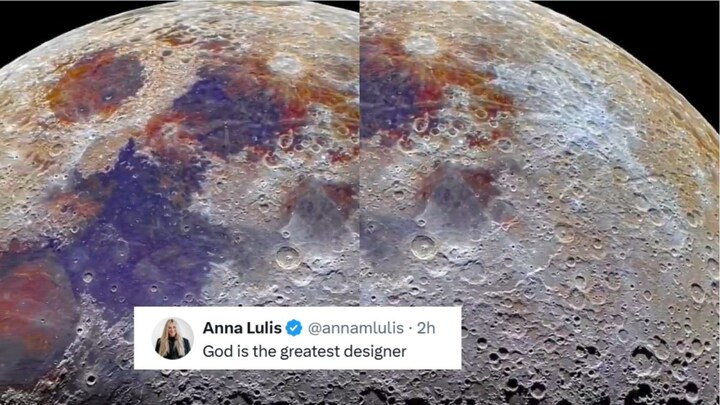
The Moon has never been presented to a global audience in a manner that feels as intimate as standing a few kilometres above a dusty plain and observing every ridge, crater and subtle texture. An ultra‑high‑definition video, currently circulating across multiple social‑media platforms, offers precisely that sensation. The footage presents a view of the Moon that is so sharp that individual ridges along the Mare, deep craters with shadowed interiors, and faint surface undulations appear with a clarity previously reserved for scientific publications or mission‑specific releases.
From the moment the video appeared online, it sparked a cascade of comments, shares, and inquiries. The central question emerging from the online conversation is whether the video constitutes an official leak from the Artemis II mission, or whether it originates from a ground‑based astrophotography effort that pushes the limits of current telescope technology.
Initial Assumptions Tied to Artemis II Mission
Because Artemis II mission dominates headlines related to lunar exploration, many observers immediately linked the spectacular visual to the Orion spacecraft as it made its orbital pass around the Moon. The level of immersion within the video—feeling as though a camera moves in real time over the lunar terrain—reinforces that intuition. Viewers familiar with past releases from NASA notice that official videos typically juxtapose the Orion spacecraft silhouette against the lunar backdrop, while the current clip provides a tightly focused, stable, and incredibly detailed surface view that lacks any spacecraft framing.
NASA’s recent media outreach has indeed showcased breathtaking images captured by Orion, yet those releases differ in composition. The viral footage’s focus on a fixed patch of terrain, combined with a smooth pan that lacks any apparent motion blur, suggests that the source may stem from a different acquisition method altogether.
Technical Breakdown of the Video’s Origin
Several posts on social platforms attribute the video to an elaborate post‑processing workflow involving thousands of individual frames. According to an Instagram user named Adam Kyle Jackson, the video resulted from stacking one thousand frames captured with a Nikon Z8 camera attached to a Takahashi TSA‑120 telescope, supplemented by a Takahashi 1.5x Extender mounted on a ZWO AM5 tracking system. The resulting composite yields a 40‑megapixel image of the Moon, which was then animated to simulate a gentle glide across the surface.
Each component of the described setup serves a specific purpose. The Nikon Z8, known for its high resolution and low‑noise sensor, supplies the raw pixel data. The Takahashi TSA‑120 telescope, a refractor designed for planetary observation, delivers the necessary magnification and optical clarity. The Takahashi 1.5x Extender increases effective focal length, sharpening surface details further. Finally, the ZWO AM5 mount provides precise tracking, allowing the camera to follow the Moon’s apparent motion across the sky while maintaining sub‑arcsecond stability. By aggregating a thousand individual frames, the final image smooths atmospheric turbulence, reduces random noise, and enhances fine textures that would otherwise be invisible in a single exposure.
These technical specifics align with established astrophotography practices that push the limits of ground‑based imaging. The outcome—an ultra‑sharp, stable visual of the Moon—mirrors what some viewers initially expected only from an in‑situ spacecraft camera.
Viral Spread and Public Reaction
The video’s rapid circulation has generated a torrent of reactions across platforms ranging from short‑form video services to discussion forums dedicated to space exploration. Users marvel at the level of detail, often describing the experience as “seeing the Moon with our own eyes” or “a window directly onto the lunar landscape.” The phrase “impossible detail” recurs throughout comments, underscoring the widespread perception that the visual surpasses conventional expectations.
One commenter, identifying as a technology enthusiast, humorously imagined a future where the Moon hosts massive data‑center facilities, stating, “Imagine all the data centers this bad boy can host.” While light‑hearted, the remark reflects a growing cultural conversation about the Moon as a potential frontier for infrastructure.
Another user expressed a desire for complementary footage, asking for a similarly high‑definition video of the lunar far side, often called the “dark side of the Moon.” The request signals a collective appetite for continued visual exploration of lunar regions that remain hidden from Earth‑bound observers.
Some participants in the discussion turned their attention to the broader implications for scientific knowledge. One participant wrote, “Overtime, looks like, we’ll get to learn more about the Moon, and realize that the things we learned earlier weren’t everything we learned and there is a lot to learn more and more and more……” The sentiment captures a sense of evolving understanding, acknowledging that each new visual breakthrough expands the repository of lunar knowledge.
Context Within Ongoing Lunar Exploration Efforts
While the video itself does not constitute a direct data feed from an active mission, its existence—whether produced by Adam Kyle Jackson or another skilled amateur—demonstrates how modern equipment can bridge the gap between professional mission imagery and public visual experience. The video arrives at a moment when Artemis II mission captures public imagination, reminding observers that cutting‑edge ground‑based observation can complement official spaceflight assets.
The synergy between mission‑derived materials and high‑quality amateur imaging enriches the public’s perception of lunar geography. By providing a view that rivals or even exceeds certain officially released frames, the viral clip encourages a dialogue about the democratization of space observation, where dedicated hobbyists leverage advanced cameras and telescopes to generate visuals that resonate worldwide.
Implications for Future Content Creation
The excitement surrounding the video suggests a growing demand for similarly immersive lunar footage. Whether through upcoming Artemis missions, future lunar orbiters, or continued advances in amateur astrophotography, audiences appear eager for more high‑resolution visual storytelling of the Moon’s terrain. The request for far‑side coverage, for instance, hints at an appetite for comprehensive lunar panoramas that encompass both near‑side and hidden regions.
In addition, the viral success underscores the power of social media as a distribution channel for scientific and educational content. By circulating a video that blends scientific rigor with aesthetically compelling presentation, creators can reach audiences far beyond traditional academic circles, fostering a broader appreciation for space science.
Closing Perspective
In sum, the viral Moon clip stands as a testament to how modern imaging technology, when combined with meticulous post‑processing, can produce visuals that rival those once thought exclusive to space agencies. Whether the footage originates from a sophisticated ground‑based setup described by Adam Kyle Jackson or from another undisclosed source, the result invites viewers to contemplate the Moon’s surface with a clarity that feels almost tangible. The conversation sparked by the video—spanning speculation about Artemis II mission leaks, jokes about lunar data centers, and pleas for far‑side footage—highlights a vibrant public fascination with our nearest celestial neighbor. As humanity continues its journey back to the Moon, such visual experiences will likely play an essential role in shaping public expectation, scientific curiosity, and cultural imagination.