India’s Badminton Prospects Diminish as Treesa Jolly and Gayatri Gopichand Pullela Withdraw from Asian Championships
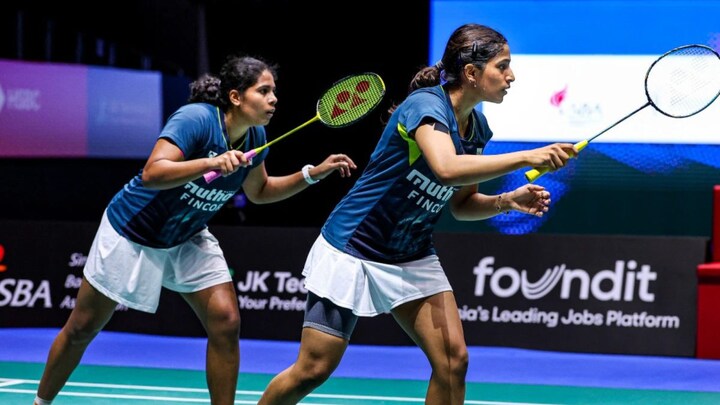
Withdrawal of a Key Women’s Doubles Pair Deepens India’s Challenges
India’s campaign at the Badminton Asia Championships has encountered a fresh impediment. After the earlier exit of the renowned men’s doubles duo Satwiksairaj Rankireddy and Chirag Shetty, the tournament has now been further deprived of the participation of the women’s doubles partnership Treesa Jolly and Gayatri Gopichand Pullela.
The exact cause behind the decision of Treesa Jolly and Gayatri Gopichand Pullela to withdraw remains undisclosed. However, multiple reliable sources have independently corroborated the development, underscoring the growing uncertainty surrounding India’s chances in the doubles categories.
With both the male and female doubles contingents now facing unexpected gaps, the overall composition of India’s representation has shifted dramatically, prompting analysts and supporters alike to reassess the nation’s strategic outlook for the remainder of the competition.
Singles Contenders Rise to the Forefront
In the wake of these withdrawals, the spotlight inevitably pivots toward the singles discipline, where India still retains a cadre of high‑profile athletes capable of delivering strong performances. Two figures stand out as the primary bearers of hope: Lakshya Sen and PV Sindhu.
Lakshya Sen approaches the championship with a series of recent successes that have bolstered confidence both within the camp and among the broader badminton community. The momentum generated by Lakshya Sen’s recent form positions the player as a legitimate contender for a deep run in the tournament.
PV Sindhu, a veteran of the international circuit, brings a blend of experience, tactical acumen, and a proven track record in major championships. PV Sindhu’s presence on the court consistently raises the level of competition and provides a psychological edge for teammates.
The convergence of Lakshya Sen’s current vigor and PV Sindhu’s seasoned expertise creates a compelling narrative for India’s pursuit of a continental singles title, a goal that has remained elusive for an extended period.
Depth of the Men’s Singles Field
Beyond the headline names of Lakshya Sen and PV Sindhu, India’s men’s singles roster includes additional athletes who will be tasked with navigating challenging early‑round matches. HS Prannoy, who has recently recovered from a shoulder injury, is scheduled to meet a qualifier in the opening round.
Kidambi Srikanth will confront Singapore’s Loh Kean Yew, a competitor known for aggressive shot placement and strategic versatility. This encounter promises to be a test of resilience and adaptability for Kidambi Srikanth.
Ayush Shetty, fresh from a victory at the United States Open, faces the Chinese representative Li Shi Feng. The contrast between Ayush Shetty’s recent triumph and Li Shi Feng’s established reputation adds a layer of intrigue to the matchup.
Women’s Singles Landscape for India
In the women’s singles division, PV Sindhu remains the flagship competitor, shouldering the expectation of delivering a medal‑winning performance. Complementing PV Sindhu’s campaign are rising talents who will encounter formidable opponents in their respective first‑round draws.
Unnati Hooda is slated to battle Thailand’s Supanida Katethong, a player recognized for her swift footwork and tactical variation. Tanvi Sharma will measure skills against a Malaysian adversary, while Malvika Bansod faces a Thai opponent, each encounter representing a critical stepping stone toward potential advancement.
The collective effort of these athletes underscores India’s commitment to fielding a competitive presence across all singles categories despite the setbacks affecting the doubles disciplines.
Increasing Obstacles for the Doubles Squads
With the departures of Satwiksairaj Rankireddy and Chirag Shetty from the men’s doubles event and the withdrawal of Treesa Jolly and Gayatri Gopichand Pullela from the women’s doubles competition, India’s remaining doubles pairings face heightened pressure to deliver results against formidable opposition.
In the men’s doubles bracket, the partnership of Hariharan Amsakarunan and M R Arjun will encounter the top‑seeded Korean duo in their opening match. This confrontation pits a relatively less‑tested Indian pair against seasoned opponents who have consistently demonstrated dominance at the continental level.
India’s mixed doubles representation features the duo of Rohan Kapoor and Dhruv Kapila, who will meet strong challengers from Malaysia and Thailand. The mixed doubles draw places Rohan Kapoor and Dhruv Kapila in a situation where strategic coordination and on‑court chemistry will be decisive factors in determining the outcome of each match.
The cumulative impact of these tough draws, combined with the earlier exits of two of India’s premier doubles pairs, amplifies the narrative of a challenging tournament trajectory for India’s doubles contingent.
Strategic Outlook and Implications for Future Campaigns
The sequence of withdrawals and injury‑related absences serves as a stark reminder of the unpredictable nature of elite competition. For India, the experience gleaned from navigating this particular championship—despite setbacks—will inform preparation strategies for subsequent international events.
Key lessons emerging from the current scenario include the importance of depth in the squad, the need for contingency planning when primary pairings become unavailable, and the value of robust conditioning programs designed to minimize injury risk among top athletes.
Moreover, the heightened reliance on singles performers such as Lakshya Sen, PV Sindhu, HS Prannoy, Kidambi Srikanth, Ayush Shetty, Unnati Hooda, Tanvi Sharma, and Malvika Bansod emphasizes the necessity of nurturing a broader base of talent capable of stepping into pivotal roles when the circumstances demand.
As the championship progresses, the performances of these individuals will not only shape the immediate outcome for India but also contribute to a longer‑term narrative about the nation’s resilience and adaptability on the Asian badminton stage.