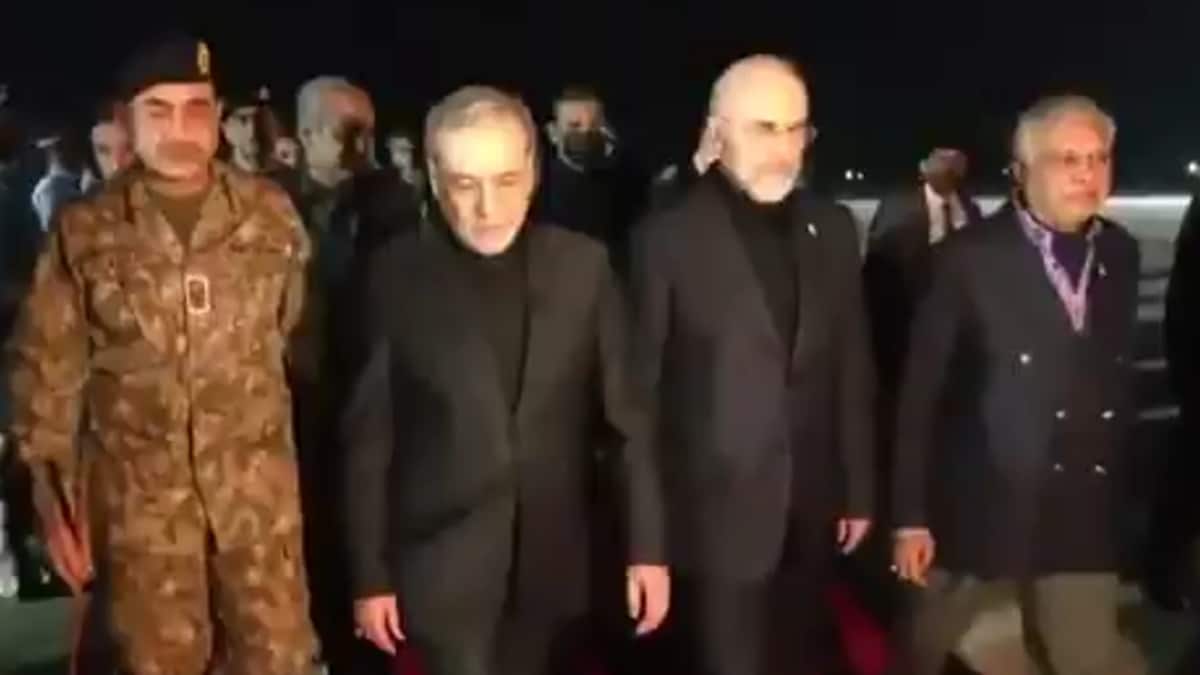
Iranian delegation was received by Pakistan’s Foreign Minister Ishaq Dar, Army Chief Asim Munir and other high‑ranking Pakistani officials.
When I first heard that the Iranian delegation, led by Parliament Speaker Mohammad‑Bagher Ghalibaf, had touched down in Islamabad, I could almost feel the buzz in the chai stalls near the airport. The traffic was a bit jammed – a typical Monday morning in the capital – but there was a strange excitement in the air, as if even the usual honking cars were pausing to listen.
Two sleek aircraft, IRAN04 and IRAN05, appeared on the runway, their white tails flashing under the morning sun. I saw them on a flight‑tracking app, Flightradar24, and thought, “Yeh bas diplomatic ka show shuru ho gaya.” The planes landed smoothly at the airfield just outside Islamabad, and a few minutes later, a convoy of black Mahindra SUVs rolled out, carrying the delegation.
Pakistan’s Foreign Minister Ishaq Dar, Army Chief Asim Munir and a number of other senior Pakistani officials were already waiting. The Greeting was formal, yet you could see the curves of smiles trying to hide the weight of the mission.
Who was in the Iranian team?
The group that arrived with Parliament Speaker Mohammad‑Bagher Ghalibaf was quite extensive. Alongside Parliament Speaker Mohammad‑Bagher Ghalibaf, there was Foreign Minister Seyed Abbas Araghi, Defence Council Secretary Ali Akbar Ahmadian, Central Bank Governor Abdolnaser Hemmati and several members of Parliament. They all wore matching suits, a clear sign that they were travelling together for a purpose beyond routine visits.
According to the Iranian Embassy in India’s post on X, the wording was very clear: “Iran’s negotiating team led by Parliament Speaker Mohammad‑Bagher Ghalibaf arrives in Islamabad. Accompanying Ghalibaf are Foreign Minister Seyed Abbas Araghi, Defence Council Secretary Ali Akbar Ahmadian, Central Bank Governor Abdolnaser Hemmati and several lawmakers.” I read that post while waiting for a bus to the Serena Hotel, where most of the talks were supposed to happen.
US delegation on its way
Just as the Iranian side was making its grand entrance, the United States delegation was already on its way to Islamabad. Vice President JD Vance was heading there, leading a team that left for the capital on a Friday. Before departing, Vice President JD Vance warned Iran not to try to “play” Washington – a line that was quoted in the news and echoed in the corridors of the hotel where I was staying.
Vice President JD Vance’s message was blunt: “If they’re going to try to play us, then they’re going to find the negotiating team is not that receptive.” It sounded like a warning that was meant for both Tehran and anyone watching from a distance.
What’s on the agenda?
Official sources said the talks in Islamabad would revolve around several sensitive issues. First, Iran’s nuclear enrichment programme – a topic that has been the centre of many diplomatic headaches for years. Second, the free flow of trade through the Strait of Hormuz, a crucial oil conduit that keeps the world’s energy markets ticking. Those two points, combined with the broader quest for a lasting peace, formed the backbone of the agenda.
From the perspective of a regular citizen like me, it felt like watching a high‑stakes cricket match where every ball could change the outcome. The players were big‑named politicians, but the stakes affected ordinary people too – especially those living in cities that rely on oil imports.
Iran’s pre‑conditions
Parliament Speaker Mohammad‑Bagher Ghalibaf had already set out two clear conditions before stepping foot in Islamabad. In a post on X, Parliament Speaker Mohammad‑Bagher Ghalibaf wrote: “Two of the measures mutually aGreed upon between the parties have yet to be implemented: a ceasefire in Lebanon and the release of Iran’s blocked assets prior to the commencement of negotiations. These two matters must be fulfilled before negotiations begin.”
So, the Iranian side wanted a ceasefire in Lebanon and the release of its blocked assets. Both points were non‑negotiable for them, and they made it very clear that without these, the talks would not move forward.
Meanwhile, the United States was sending subtle signals that they would not be easily swayed, keeping their military forces on a “hair‑trigger alert,” as the White House put it. The whole scenario reminded me of the tension you feel while waiting for a traffic light to turn Green at a crowded intersection – you know you must be patient, but you also know the moment can change in a split second.
The venue: Serena Hotel
The talks were being held at the Serena Hotel, a place I had visited once for a wedding. It’s a fancy spot, with marble floors and chandeliers that make you feel like you’re in a palace. The hotel was fully requisitioned for diplomatic use – security personnel lined the corridors, and the air hummed with the low murmur of translators.
Pakistani Prime Minister Shehbaz Sharif described the situation as “make or break.” The same phrase was repeated in briefings, and you could hear it whispered in the cafe where I was sipping my tea. It felt like a deadline that was both exciting and terrifying for everyone involved.
On the ground: my observations
Walking around the hotel, I saw the Iranian delegation’s members – Parliament Speaker Mohammad‑Bagher Ghalibaf, Foreign Minister Seyed Abbas Araghi, Defence Council Secretary Ali Akbar Ahmadian, Central Bank Governor Abdolnaser Hemmati – each taken to separate meeting rooms. They were constantly flanked by security agents and interpreters, and there were occasional bursts of conversation that I could not grasp fully.
During lunch, I glanced at the menu – it featured both Pakistani and Iranian dishes, a subtle reminder of the cultural ties that still exist despite political friction. The taste of kebabs and saffron rice made me think about how food can sometimes bridge gaps where politics cannot.
Later that evening, I saw a news crew setting up near the hotel’s garden, ready to broadcast any updates. The atmosphere was tense, yet hopeful – a mixture you often find at an Indian railway station during a monsoon, when everyone hopes the train will finally arrive.
Highlights from the discussions
Although I was not allowed inside the closed‑door rooms, I managed to catch snippets from briefings. Parliament Speaker Mohammad‑Bagher Ghalibaf repeatedly stressed the need for a ceasefire in Lebanon, while Central Bank Governor Abdolnaser Hemmati kept mentioning the blocked assets that Tehran wants released. Meanwhile, Vice President JD Vance’s team seemed focused on Iran’s nuclear enrichment, asking pointed questions about the level of uranium enrichment and the timeline for any possible roll‑back.
Army Chief Asim Munir, who was present during the reception, was seen taking notes and occasionally nodding, signalling that the Pakistani side was trying to keep the discussions balanced. Pakistan’s Foreign Minister Ishaq Dar also played the role of a mediator, often the one who would calm down heated moments with a gentle “let’s take a step back and think about the larger picture.”
The whole scene reminded me of a family dinner where multiple generations argue, but at the end of the day, everyone wants the best for the family.
What the world is watching
Across the globe, analysts were watching the Islamabad talks as if they were a live cricket match, each ball (or diplomatic point) potentially shifting the outcome. The United States was keeping its military posture tense, while Iran’s state media insisted that talks would only go ahead if Washington accepted Tehran’s pre‑conditions.
In most cases, the media coverage was a blend of optimism and skepticism. Some pundits wrote about the “possibility of a breakthrough,” while others warned that “any misstep could reignite old hostilities.” As a local observer, I found the mix of hope and caution somewhat similar to the feeling you get when a monsoon storm approaches – you know it will bring relief, but you also brace for the strong winds.
Potential outcomes
If the talks succeed, the immediate benefit would be a reduction in tensions around the Strait of Hormuz, which would be good news for shipping companies and for Indian exporters who rely on oil imports. A ceasefire in Lebanon would also mean less instability in the region, potentially easing the flow of refugees and reducing the risk of larger conflicts.
On the other hand, if the negotiations stall, the situation could deteriorate further. The United States might increase its military readiness, and Iran could tighten its nuclear activities – a scenario that would keep the whole of South Asia on edge.
From my perspective, the best case is a “step‑by‑step” approach, where both sides aGree on smaller, confidence‑building measures first. That way, the larger issues can be tackled gradually, much like how we negotiate a rent increase with a landlord – you start with a small concession before moving to the bigger concerns.
Final thoughts
Being in Islamabad during these high‑stakes talks felt like witnessing history being written in real time. The presence of Parliament Speaker Mohammad‑Bagher Ghalibaf, Foreign Minister Seyed Abbas Araghi, Defence Council Secretary Ali Akbar Ahmadian, Central Bank Governor Abdolnaser Hemmati and several members of Parliament brought a sense of gravitas to the entire affair. At the same time, Vice President JD Vance’s delegation added a layer of urgency that made the atmosphere feel almost electric.
What stood out to me the most was the human element – the nervous smiles, the cautious handshakes, the quiet tea breaks where officials tried to collect themselves. Those small moments made the whole diplomatic dance feel less abstract and more relatable, like watching neighbours argue over a boundary wall but hoping they will eventually find a solution that benefits everyone.
In the end, whether the talks result in a lasting peace or a brief pause, they have already shown how delicate and interconnected our world is. As I walked back through the bustling streets of Islamabad, the sounds of traffic and market haggling seemed to echo a simple truth: that ordinary people keep moving forward, no matter how big the diplomatic storms around them.