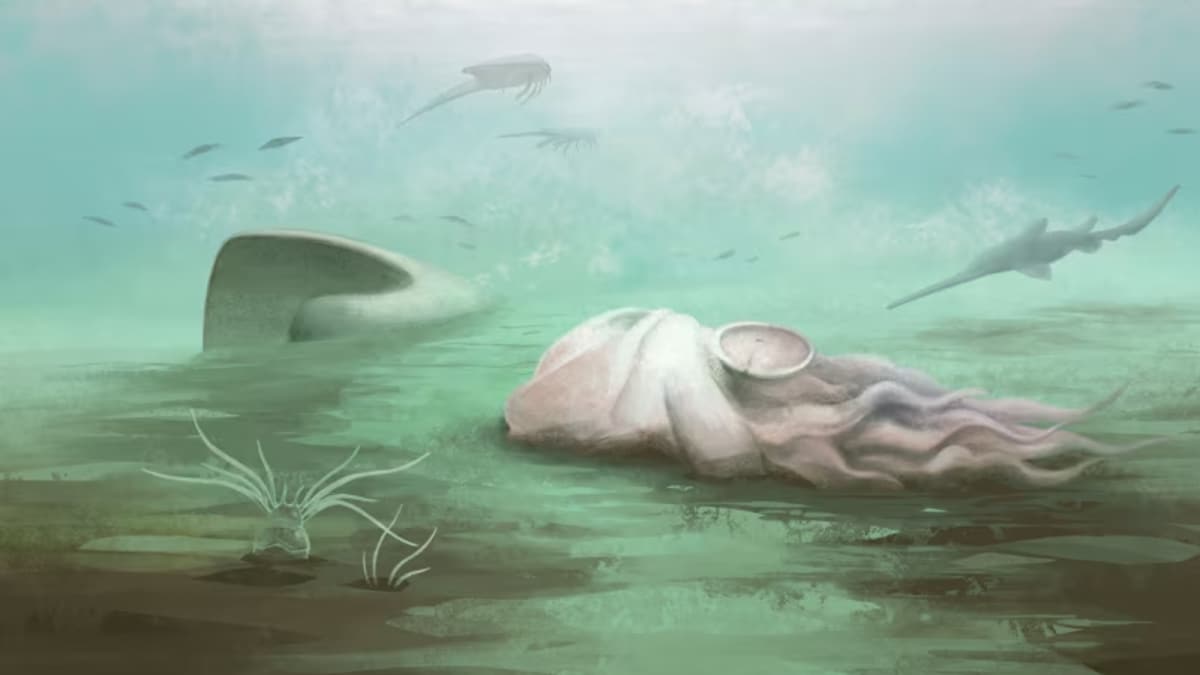
For years, 'Pohlsepia mazonensis' was believed to be the earliest known octopus, with what appeared to be eight tentacles, eyes, and possibly an ink sac
Let me tell you a little story about how I first heard of Pohlsepia mazonensis. It was during a rainy afternoon in Mumbai, when I was scrolling through some science news on my phone while waiting for the local train to start moving again. The headline shouted that a 300‑million‑year‑old octopus had been found, and my mind instantly went to the seafood stalls in Chowpatty where we sometimes see octopi being grilled for dinner. I thought, "Wow, octopuses have been around since the time of huge ferns and giant dragonflies!" That excitement made me read more, and I discovered that Pohlsepia mazonensis had even earned a place in the Guinness Book of World Records as the oldest octopus ever discovered.
The fossil itself had been retrieved from the Mazon Creek site in Illinois, USA – a place famous among paleontologists for preserving soft‑bodied creatures in ironstone concretions. When the first scientists examined Pohlsepia mazonensis, they saw what looked like eight long arms, a pair of eyes, and even a structure that resembled an ink sac. All these features matched what we know about modern octopuses, and so the scientific community started to accept the idea that octopuses existed far earlier than previously thought.
Fast forward to the present, and a team of researchers from the University of Reading decided to take another look at Pohlsepia mazonensis using a technique called synchrotron imaging. I remember watching a short documentary about synchrotrons on a streaming platform; they are like giant X‑ray machines that can see inside rocks without breaking them. The scientists pointed this powerful beam at the fossil, hoping to uncover hidden details that older methods might have missed.
What they saw was surprising – rows of tiny teeth that ran along the edge of the fossil. These teeth were arranged in a pattern of eleven per row, which is very different from the few, tiny, seldom‑visible teeth you would expect on an octopus. In fact, octopuses hardly have any teeth at all; they have a beak made of chitin, not a series of rows. The presence of these numerous tiny teeth hinted that the creature belonged to a completely different group of cephalopods.
Lead researcher Thomas Clements from the University of Reading explained, "We basically used a wide selection of new analytical techniques to discover hidden anatomical characteristics within the rock. And we were able to determine that it is not an octopus, but is actually a very decomposed nautiloid." The term "nautiloid" may sound unfamiliar to many, but it refers to a group of marine animals that includes the modern nautilus – the beautiful, spirally shelled creature you can sometimes see in aquariums in Bengaluru or Chennai.
Now, imagine being a kid in a small town in Kerala, watching a fisherman bring in a nautilus shell that looks like a tiny, perfect spiral. You would think that such a creature is really old, maybe even as ancient as the rocks we learn about in school. That intuition matches what the new research says – Pohlsepia mazonensis was more closely related to a nautilus than to an octopus. The evidence lies in the number and arrangement of those tiny teeth. While octopuses have a simple beak, nautiloids have a series of small, repetitive teeth used for catching prey.
So how did scientists get it wrong for so long? The answer, as Thomas Clements and his colleagues point out, lies in the process of decay. Before the animal became fossilised, its soft parts had already started to break down. The original shell, which would have been the most obvious clue that this was a nautiloid, was largely lost or transformed into a soft, blob‑like mass. This soft mass looked very much like the gelatinous body of an octopus, especially when viewed through older imaging techniques that could not see inside the rock.
One of the researchers described the fossil as looking like a "blob" – a vague, featureless sack that can be easy to misinterpret. When you are looking at a fossil that is 300 million years old, and you only see a vague outline, it's understandable that early scientists, working with the tools available at the time, would make an educated guess based on the most obvious features they could recognize.
The misidentification had broader implications. For a while, the scientific narrative suggested that octopuses had been swimming around the seas during the Carboniferous period – a time when massive ferns covered the land and giant insects darted about. This narrative even influenced textbooks and documentaries that I used to watch as a teenager, showing octopuses as ancient masters of the ocean.
With the new findings, the picture changes. The researchers now propose that the true origin of octopuses is likely much later, possibly during the Jurassic period – the age of dinosaurs, when the seas were already teeming with a diverse range of marine life. This shift does not diminish the wonder of octopuses; it simply places their emergence in a different chapter of Earth's history.
Thinking about this, I am reminded of the many times I have visited natural history museums in Delhi and Hyderabad. The giant displays of dinosaur skeletons often include a small section on cephalopods, but they rarely mention Pohlsepia mazonensis. Now that we know the story, I can imagine a future exhibit that explains how even the most well‑known fossils can be re‑interpreted when science advances. It also teaches a valuable lesson: science is a process, constantly refining our understanding as new tools become available.
What does this mean for the everyday person? Apart from the excitement of learning that a famous fossil was actually a different animal, it reminds us that interpretations can change. In India, we often hear about ancient fossils like the famous Indus river dolphin or the towering dinosaur tracks in Gujarat. Each discovery adds a piece to the puzzle, but the puzzle can be rearranged when someone looks at the pieces from a new angle.
On a more personal note, the story of Pohlsepia mazonensis resonates with my own experience of revisiting old memories. Just as the scientists re‑examined an old fossil with fresh eyes, I sometimes go back to my childhood photographs and notice details I missed before – a tiny scar, a funny expression, a hidden background object. Those new observations can change the story I tell about that day, making it richer and more nuanced.
In the same way, the new research on Pohlsepia mazonensis adds depth to our understanding of cephalopod evolution. It shows that the soft‑bodied marine world of the past was far more complex than we imagined, and that the process of fossilisation can sometimes hide as much as it reveals.
Looking ahead, the team led by Thomas Clements hopes to apply the same synchrotron imaging techniques to other contentious fossils from the Mazon Creek site and similar deposits worldwide. By doing so, they aim to clarify more mysteries about ancient marine life, perhaps even uncovering new species that have been hiding in plain sight inside rocks.
As a lover of marine life, I find this prospect thrilling. Imagine finding a fossil that looks like a regular fish but turns out to be an early relative of the shimmering flying fish you see off the coast of Kerala during monsoon season. Each discovery not only adds to scientific knowledge but also fuels the imagination of people like me, who love to daydream about the ancient oceans that once covered this land.
In the end, the story of Pohlsepia mazonensis is a reminder that science, much like everyday life, is full of surprises. The next time you pick up a newspaper article about a new fossil, remember that the first interpretation might not be the final one. Keep that curiosity alive, and you might just see a new side to something you thought you already knew.