Mohan Bhagwat Calls for Nationwide Cow Devotion, Suggests Ram Temple‑Style Mobilization to End Slaughter
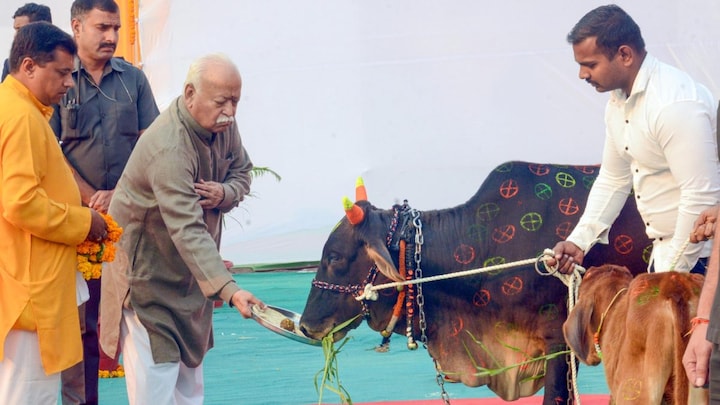
Bhagwat acknowledged the challenges of keeping cows in cities and suggested people support gaushalas (cow shelters) instead.
Mohan Bhagwat stated that the key to eradicating the practice of cow slaughter lies in shaping public consciousness. According to Mohan Bhagwat, when society internalises reverence for the cow, the demand for its killing evaporates without the need for coercive legislation.
“Make society devoted to cows (samaj ko gau bhakt banao), and cow slaughter will stop immediately. We have to make the public aware; the rest will follow," Mohan Bhagwat declared. The emphasis on awareness, rather than punitive measures, reflects a strategic choice to harness cultural sentiment as a self‑sustaining force.
In delivering these remarks, Mohan Bhagwat highlighted the difficulty of maintaining live cattle within dense urban environments. Recognising that city dwellers often lack the space and resources to care for cows, Mohan Bhagwat urged citizens to channel their compassion toward gaushalas, which are dedicated shelters that provide food, medical care, and a safe haven for cows.
“If public sentiment (jan bhavna) exists, the system has to accept it," Mohan Bhagwat asserted, indicating that a robust public feeling in favour of cow protection should be reflected in policies and administrative practices at all levels.
Mohan Bhagwat referenced a landmark judicial decision that paved the way for the construction of the Ram Temple in Ayodhya. By drawing a parallel, Mohan Bhagwat illustrated how collective resolve can translate into tangible outcomes. He explained that the Ram Temple did not materialise during an earlier political period; instead, it came to fruition after a decisive Supreme Court judgment that unified diverse stakeholders.
"The Ram Temple did not come up between 2014 and 2019. It came after 2019. Why? The Supreme Court, which used to say that it had other very important matters, gave a unanimous judgment," Mohan Bhagwat said. The reference to the Supreme Court underscores the importance of a clear, authoritative endorsement in catalysing large‑scale societal projects.
Building on that narrative, Mohan Bhagwat suggested that the same level of conviction and united purpose that propelled the Ram Temple should be directed toward protecting cows. The implication is that when a nation can rally around a symbolic edifice, it can equally rally to preserve a living symbol of cultural heritage.
Beyond the domestic arena, Mohan Bhagwat positioned India’s spiritual heritage as a potential beacon for the global community. He declared that India, drawing inspiration from its saints and deep‑rooted spiritual values, is poised to offer a fresh direction for humanity.
“India, taking inspiration from its saints and its spiritual values, will provide a new direction to the world," Mohan Bhagwat affirmed. This statement connects the domestic campaign for cow protection with a broader vision of India as a moral and cultural guide on the world stage.
On the subject of international tensions, Mohan Bhagwat argued that the present moment calls for India to emerge as a ‘Vishwa Guru,’ a universal teacher whose influence promotes peace, happiness, and harmony worldwide.
"The time has come for India to emerge as a Vishwa Guru and foster a happier, harmonious world," Mohan Bhagwat proclaimed. The aspirational label of Vishwa Guru reinforces the notion that India’s internal moral reforms have external diplomatic ramifications.
Mohan Bhagwat urged citizens to move beyond a superficial reading of sacred texts and to internalise the underlying sentiment that they convey. He emphasized that truth and compassion are inseparable from any genuine religious expression.
"There cannot be any religion without truth and compassion. Everyone should live together in harmony. Compassion enters one’s life when the suffering of others feels like one’s own suffering," Mohan Bhagwat explained. This articulation of empathy aligns with the call for a collective cow‑centric ethos.
By linking compassion to shared suffering, Mohan Bhagwat created a moral bridge that connects personal empathy with the societal shift toward cow reverence. The message proposes that protecting cows is an act of extending compassion to a vulnerable creature, thereby reflecting a broader humane principle.
When responding to Mahant Rajendra Das Maharaj’s appeal for an outright prohibition on cow slaughter, Mohan Bhagwat reiterated that the most effective strategy is to transform the public psyche itself. According to Mohan Bhagwat, turning society into devotees of the cow will automatically render the practice of slaughter extinct.
"Empower… This would be a courageous step. Cow products will be taken to every single person. The Sangh will work in this direction," Mohan Bhagwat said. The reference to cow products indicates an economic dimension in which every individual can benefit from the utilization of dairy, dung, and other cow‑derived resources, further solidifying the cow’s place in everyday life.
Mohan Bhagwat’s remarks imply that a holistic approach—combining sentiment, shelter support, economic integration, and moral teaching—can achieve the desired outcome without relying solely on legislative bans.
In closing, Mohan Bhagwat underscored that the journey toward a cow‑devoted society requires collective effort, steadfast determination, and an unwavering belief in the transformative power of cultural values. By invoking the fervour that rallied around the Ram Temple, Mohan Bhagwat presented a template for how grassroots enthusiasm can translate into lasting societal change.
The overarching message conveyed by Mohan Bhagwat is clear: when public consciousness aligns with the sanctity of the cow, the instruments of law become secondary, and the moral fabric of the nation itself becomes the guardian of the animal.
Through sustained public education, support for gaushalas, and the promotion of cow‑based products, Mohan Bhagwat believes India can set an example for the world—demonstrating that reverence for a living symbol of heritage can coexist with modern progress, peace, and global leadership.
(With inputs from PTI)
(With inputs from PTI)