Toto Wolff Says Christian Horner’s Exit Has Shattered Glass, Casting Doubt on Return
Is an Enemies‑to‑Lovers Narrative Emerging?
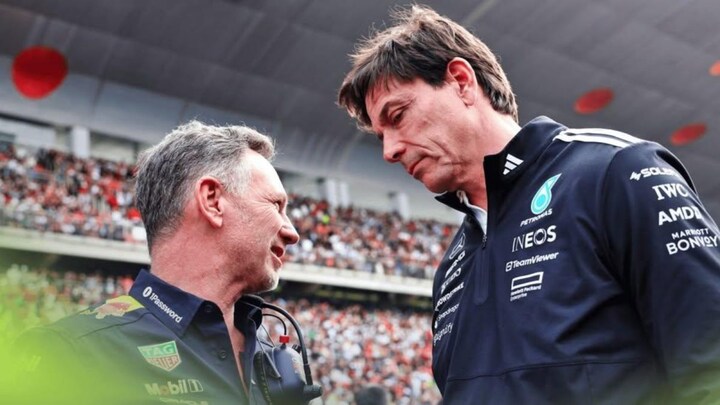
The recent remarks from Toto Wolff have ignited speculation about whether the familiar “enemies‑to‑lovers” storyline might finally be reaching a resolution between Toto Wolff and Christian Horner. The answer is a decisive negative. Rather than signaling any softening of attitudes, Toto Wolff delivered another of his trademark concise observations, underscoring the complex and unsettled nature of the dispute.
When asked about the possibility of Christian Horner returning to the top tier of motorsport, Toto Wolff did not employ any diplomatic language. Instead, Toto Wolff employed a vivid metaphor, stating that Christian Horner “has broken quite a lot of glass” and that the shattered fragments would have lasting consequences for anyone hoping to welcome Christian Horner back into the Formula 1 community.
Background to the Controversial Exit
Christian Horner’s tenure at Red Bull Racing is recorded in the sport’s history as one of the most successful periods ever witnessed. Under Christian Horner’s stewardship, Red Bull Racing accumulated eight drivers’ championships and six constructors’ championships, cementing the team’s place as a modern powerhouse. However, the dominant stretch eventually gave way to a season in which performance started to decline, and internal tensions rose sharply.
In the middle of that turbulent season, Christian Horner was dismissed from his role at Red Bull Racing. The dismissal occurred in the middle of the year following a cascade of events that included a noticeable dip in on‑track results, strategic disaGreements within the organization, and a series of high‑profile personal allegations that threatened to undermine the stability of the team.
The Allegations and Their Aftermath
The central element of the controversy surrounding Christian Horner involved serious accusations of sexual harassment and coercive, controlling behaviour made by a female employee of the team. The allegations attracted intense media scrutiny and prompted an internal investigation designed to determine the veracity of the claims.
The first investigative phase was conducted by a legal professional appointed by the organization. That internal review concluded that Christian Horner was cleared of the accusations. Nevertheless, the complainant appealed the decision, insisting that the findings were insufficient. A second, independent legal review was therefore commissioned. The outcome of that secondary examination echoed the earlier conclusion, once again dismissing the appeal and reaffirming Christian Horner’s clearance.
Despite the formal exonerations, the damage inflicted on Christian Horner’s reputation within the broader Formula 1 community proved to be profound. The public nature of the allegations, combined with the timing of the internal investigations, left an indelible mark on perceptions of Christian Horner and the environment surrounding the leadership of Red Bull Racing.
Wolff’s Assessment of the Damage Done
During a conversation with the Press Association, Toto Wolff articulated a stark view of the lingering effects of the episode. Toto Wolff emphasized that the “glass” metaphor was not a whimsical flourish, but rather a concise description of the intricate network of relationships, trust, and image that had been fractured by the series of events involving Christian Horner.
“He has broken quite a lot of glass, and these things have repercussions in our microcosm,” Toto Wolff told the Press Association. The phrase “our microcosm” referred explicitly to the tightly woven community that constitutes the Formula 1 paddock, where personal histories, professional alliances, and public perception are in constant interplay.
Toto Wolff also acknowledged that, notwithstanding the fractures, Christian Horner’s presence had contributed a distinctive vigor to the sport. Toto Wolff remarked, “I am in two minds about it. The sport is missing personalities. And Christian Horner’s personality was clearly very controversial, and that is good for the sport.” The comment highlighted a paradox: while controversy can generate friction, it also injects a certain vitality and debate that some observers deem essential for a dynamic competition.
In drawing a broader comparison, Toto Wolff referenced the situation of another team principal, Fred Vasseur. Toto Wolff observed, “It needs the good, the bad, and the ugly. And it is now only the good and the ugly left. The bad is gone.” The statement underscored Toto Wolff’s belief that the sport’s narrative richness relies on a balance of contrasting characters, and that Christian Horner’s departure had tipped that balance.
Impact on Formula 1’s Character and Public Appeal
The removal of Christian Horner from the upper echelons of Formula 1 leadership has sparked a conversation about the broader implications for the sport’s public image. Observers have noted that the sport thrives on charismatic figures who are willing to provoke strong reactions. Christian Horner, known for outspoken statements and a commanding presence, embodied that archetype.
Without that particular brand of controversy, some analysts argue that the sport may risk becoming overly homogenized, lacking the sparks that ignite fan debate and media attention. Toto Wolff’s reference to “good, bad, and ugly” reflects a belief that a mix of archetypal personalities sustains audience engagement and fuels the narrative drama that surrounds each Grand Prix weekend.
Conversely, critics of the controversy assert that the sport should elevate professionalism above theatrics. They argue that the allegations, regardless of the investigative outcomes, introduced a level of negativity that could alienate sponsors and detract from the sport’s core focus on engineering excellence and driver talent. The debate therefore remains unresolved, straddling the line between the desire for a vibrant, polarizing figure and the need for a respectful, inclusive environment.
Prospects of Reconciliation Between Long‑Standing Rivals
When asked whether a future alliance could be forged between Toto Wolff and Christian Horner, Toto Wolff delivered an unequivocal response. “Would I consider that Christian Horner could ever be an ally or someone that shares objectives? I don’t think so,” Toto Wolff said. The definitive nature of the statement leaves little room for speculation about any imminent partnership.
Nevertheless, Toto Wolff introduced a nuanced layer to the discussion by acknowledging a philosophical perspective that even the fiercest adversary might possess redeeming qualities. “You need to remind yourself that even your worst enemy has a best friend, so there must be some goodness,” Toto Wolff observed. This reflection suggests that Toto Wolff recognizes a human dimension beyond the professional rivalry.
Adding a touch of wistfulness, Toto Wolff imagined an alternate reality in which the two figures could have shared informal moments. “I am sure I could have hung with Christian Horner over dinner and had a laugh,” Toto Wolff mused. The hypothetical scenario underscores how personal chemistry, stripped of competitive pressure, might have manifested under different circumstances.
Despite the contemplative tone, Toto Wolff reaffirmed that the current timeline does not accommodate such a reunion. The statement “Just not in this timeline. Not anymore” encapsulated a final, decisive closure on the prospect of immediate reconciliation.
Conclusion: The Ongoing Narrative
The saga involving Toto Wolff and Christian Horner illustrates how personal dynamics can intersect with professional trajectories in the high‑stakes arena of Formula 1. Toto Wolff’s vivid metaphor of broken glass continues to resonate as a reminder that once trust is fractured and reputations are challenged, rebuilding is a process fraught with complexity.
While Christian Horner’s achievements during his tenure at Red Bull Racing remain undeniable, the shadow cast by the allegations and subsequent investigations has indelibly altered the perception of his legacy. Toto Wolff’s comments, conveyed through the Press Association, reflect a broader sentiment within the paddock: the sport thrives on a mosaic of personalities, and the removal of a controversial figure may leave a noticeable void.
Looking ahead, the Formula 1 community will watch closely to see how the balance of “good, bad, and ugly” evolves. Whether new figures emerge to fill the space left by Christian Horner or whether the sport recalibrates its narrative emphasis, the ongoing discourse underscores the enduring importance of character, controversy, and the delicate interplay of personal and professional realms in shaping the sport’s future.