Two Friends Clash in Gurugram as SUVs Are Rammed Repeatedly, Viral Video Sparks Outrage
A dispute that began as a heated argument quickly turned into a perilous confrontation on a dusty road in Dhanwapur, with each Mahindra Scorpio being driven into the other multiple times.
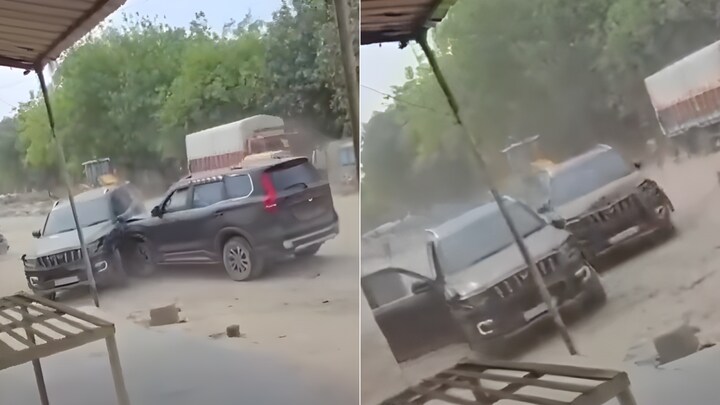
A heated argument between two friends in Gurugram spiralled into a shocking road rage incident, with both ramming SUVs repeatedly.
The clip that has circulated widely across social platforms captures a scene that appears almost cinematic in its intensity. In the footage, the two friends, each behind the wheel of a Mahindra Scorpio, accelerate toward one another on a dusty stretch of road that runs through Dhanwapur, a village within Gurugram’s sprawling metropolitan area.
What begins as a verbal exchange quickly devolves into a series of deliberate accelerations and collisions. The first impact occurs head‑on, the massive steel bodies of the Mahindra Scorpio vehicles meeting with a deafening crush that reverberates through the surrounding environment. The impact is followed almost immediately by side‑to‑side contact, as each driver appears determined to force the other vehicle backward.
Each subsequent collision is captured from a slightly altered angle, showing the two friends repeatedly manoeuvring their Mahindra Scorpio vehicles into the path of the other. The sequence repeats several times, with each Mahindra Scorpio being thrust forward, striking the opposing Mahindra Scorpio, and then recoiling just enough to prepare for another aggressive maneuver.
Onlookers, who appear to be residents of the nearby houses and passersby travelling through Dhanwapur, are shown hurriedly stepping back from the edge of the road. Their faces convey shock, fear, and an urgency to distance themselves from the unfolding danger. Some individuals are filmed clutching their belongings, while others appear to be raising their hands in a futile attempt to halt the reckless behaviour.
The video also captures a moment in which a man steps out of his Mahindra Scorpio, grabs a stone from the ground, and attempts to hurl it toward the opposing Mahindra Scorpio as it speeds away. The act underscores the heightened emotions and the escalating aggression that have come to dominate the encounter.
Local ward councillor Dinesh Dahiya, who represents the area encompassing Dhanwapur, confirmed that the two friends have known each other for an extended period and share a residence within the same neighbourhood. Dinesh Dahiya’s statement added to the bewilderment of many observers, who found it difficult to reconcile the image of long‑time acquaintances with the visible willingness to endanger public safety for a personal quarrel.
Following the rapid spread of the video, law‑enforcement officials arrived at the scene, directing both friends to the police station for questioning. Although an official complaint was not lodged by either party, the police recorded the incident and later facilitated a meeting between the two friends to discuss a mutually aGreeable resolution.
The outcome of the meeting resulted in both friends issuing public apologies for their conduct. In addition, the families of the two friends drafted a written aGreement that documented the settlement of the dispute. No formal case was entered into the legal system, and the incident concluded without further judicial involvement.
Public Reaction and Social‑Media Commentary
The rapid circulation of the video sparked a torrent of commentary across a variety of social‑media platforms. Users expressed a broad spectrum of emotions, ranging from disbelief to condemnation, and many highlighted concerns regarding road safety and the broader implications of such reckless conduct.
One commentator described the environment surrounding Gurugram in stark, critical terms, stating that the area had descended into a “cesspool” populated by “primitive, low‑life peasants.” The description, while harsh, reflected the commentator’s frustration with what was perceived as a culture of impunity and reckless behaviour that appeared to be thriving in the wake of rapid urban development.
Another user directed a query toward the local traffic authority, tagging the official regional traffic handle and asking whether any lawful action had been taken against the two friends for endangering lives and engaging in dangerous driving. The question underscored a broader public demand for accountability and a formal response from authorities tasked with maintaining road safety in Gurugram.
A third commentator framed the entire episode as an “ego‑driven” clash, observing that the vehicles themselves suffered damage as a direct result of personal pride and the unwillingness of the two friends to de‑escalate the situation. The sentiment echoed a common theme in the online discourse, wherein many observers saw the incident as a cautionary tale about the destructive potential of unchecked ego.
Beyond the immediate emotional reactions, several users highlighted the potential legal ramifications that could have arisen had the two friends chosen to pursue formal complaints. In Indian motor‑vehicle law, intentional reckless driving that places the public at risk can attract severe penalties, including fines, licence suspension, and even imprisonment. The absence of an official complaint, therefore, left the incident in a legal gray area, prompting discussion about the role of personal accountability versus formal legal processes.
Some observers also reflected on the broader societal context, noting that rapid urban expansion in areas such as Gurugram often brings with it an increase in vehicle ownership, heightened traffic congestion, and, occasionally, a decline in road‑discipline. The incident involving the two friends was cited as an example of how personal grievances, when expressed through the medium of motor vehicles, can quickly morph into public safety hazards.
Analysis of the Road‑Rage Dynamics
The incident provides a vivid illustration of how road‑rage can evolve from a verbal dispute to a physical confrontation involving heavy vehicles. Several elements contributed to the escalation:
- Proximity of the two friends: Both Mahindra Scorpio vehicles were positioned closely enough to permit rapid head‑on contact, which eliminated any natural buffer that might have de‑escalated the situation.
- Availability of a powerful vehicle: The Mahindra Scorpio, being a robust SUV, offers significant mass and acceleration capabilities, which can amplify the impact of a collision and increase the perceived intimidation factor.
- Public setting: The dusty village road in Dhanwapur is a public thoroughfare, meaning that any aggressive use of a vehicle directly endangers pedestrians, by‑standers, and any other road users.
- Emotional intensity: The footage captures moments of heightened emotional expression, including shouted words, rapid acceleration, and the use of a stone as a projectile, all of which amplify the sense of danger.
These components combined to create a scenario in which the two friends repeatedly chose to prioritize personal conflict over public safety. The repeated impacts suggest a deliberate intent to confront rather than an accidental loss of control.
From a traffic‑safety perspective, the incident exemplifies the importance of early de‑escalation techniques. Road‑rage experts recommend that drivers who feel threatened should reduce speed, maintain a safe distance, and, if possible, disengage from the offending driver. The choice made by the two friends to accelerate toward one another directly contradicts best‑practice guidelines, thereby increasing the risk of severe injury or death for any unintended by‑standers.
Furthermore, the presence of an on‑lookers’ reaction—fleeing the scene, shouting for the drivers to stop—signifies that the local community recognized the imminent danger. Such community responses can sometimes deter further escalation, yet in this case the two friends persisted, thereby highlighting the depth of personal animosity involved.
Legal and Administrative Follow‑Up
After the police arrived, the two friends were escorted to the local police station for a routine inquiry. While no official complaint was lodged by either party, law‑enforcement officers documented the statements made by the two friends and recorded the physical condition of the two Mahindra Scorpio vehicles.
Subsequent to the on‑scene investigation, local officials, including Dinesh Dahiya, facilitated a dialogue between the two friends and their respective families. The dialogue resulted in a written accord that outlined the steps each party would take to resolve the dispute amicably. The accord included mutual apologies, a commitment to refrain from future aggressive driving, and an aGreement that no further legal action would be pursued.Despite the lack of a formal case, the incident remains on record as a notable example of a road‑rage episode that was resolved through community mediation rather than courtroom proceedings. The decision not to pursue formal charges has been a point of discussion among legal experts, some of whom argue that the absence of an official complaint might set a precedent that could embolden similar behaviour in the future.
The incident also prompted local authorities to issue a reminder to residents of Gurugram about the legal consequences of reckless driving. Traffic officials reiterated that any act that endangers lives can attract strict penalties under the Motor Vehicles Act, regardless of whether a formal complaint has been filed.
Broader Implications for Public Safety in Gurugram
Gurugram, known for its rapid urban growth and high vehicle density, faces ongoing challenges related to road safety. The episode involving the two friends highlights several systemic concerns:
- Vehicle‑related conflict resolution: When personal disputes become expressed through the medium of motor vehicles, the potential for public harm escalates dramatically.
- Enforcement visibility: The presence of law‑enforcement officers at the scene was instrumental in preventing further damage, underscoring the need for sustained traffic patrols in high‑risk zones.
- Community awareness: The prompt reaction of by‑standers demonstrated an acute awareness of the dangers posed by road‑rage, suggesting that continued public education campaigns could further empower citizens to intervene safely.
Experts suggest that a combination of stricter enforcement of traffic regulations, enhanced driver‑education programs that address emotional regulation, and community engagement initiatives can help mitigate similar incidents in the future.
In the wake of the viral video, several local NGOs have pledged to organize workshops focused on responsible driving and conflict de‑escalation. These workshops aim to equip drivers with practical tools to manage anger while behind the wheel, thereby reducing the likelihood that personal grievances will be acted upon through dangerous maneuvers.
Overall, the incident involving the two friends serves as a stark reminder that the consequences of a momentary lapse in judgment can reverberate far beyond the individuals directly involved, affecting the safety and sense of security of an entire community.