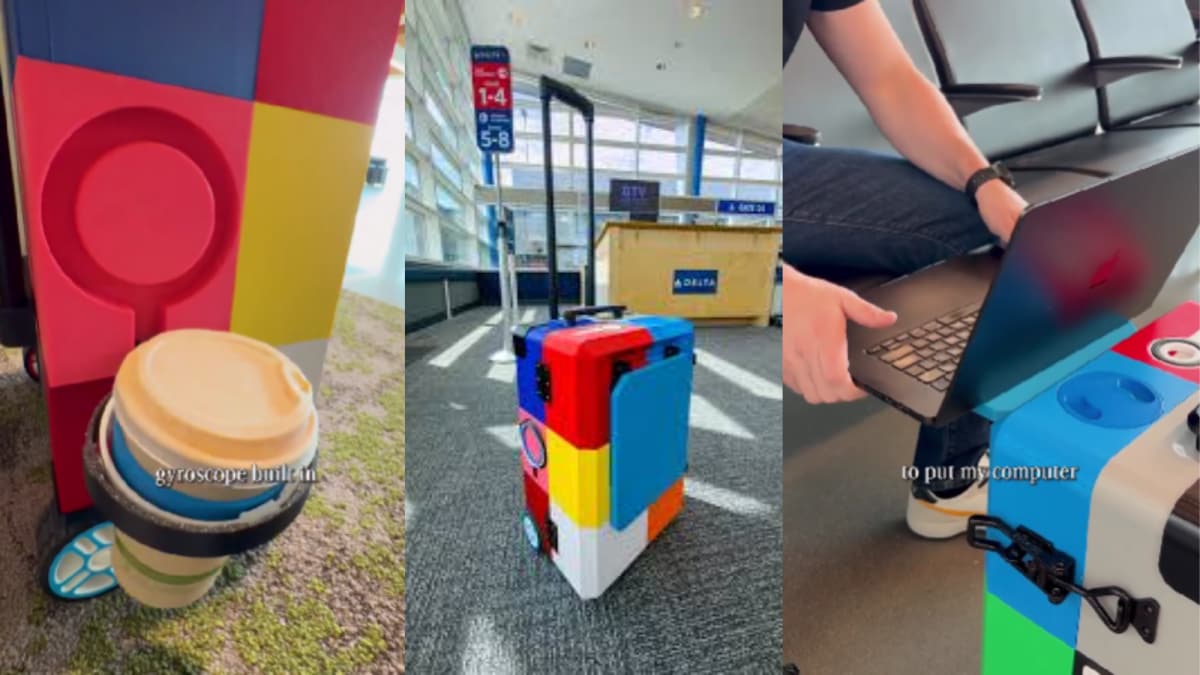
Why I decided to 3D print my own suitcase
Honestly, the idea came to me while I was stuck at Indira Gandhi International Airport, sipping a lukewarm cup of chai and trying to keep my laptop steady on the plastic tray that the airline gave us. You know those little metal trays that wobble the moment you try to type? I thought, "What if I just had a small, sturdy table that was part of my bag?" That simple frustration, mixed with a bit of boredom during a long lay‑over, sparked the whole project.
Being a creator who loves making “unnecessary inventions” – I even have that as my online handle – I started sketching ideas on a napkin. The main goal was clear: make travelling a little more comfortable without having to carry extra gadgets. I also wanted to prove that a hobbyist 3D printer could produce something genuinely useful, not just a decorative key‑chain.
So, I set up my small home studio in a corner of my Bengaluru apartment, dusted off the Ultimaker I had bought a couple of years ago, and began the design process. I made sure every new feature could be printed with the filament I already had – PLA for the main body, a bit of TPU for the flexible bits, and some transparent PETG for the little screen cover.
The flip‑up table – my airport lifesaver
First thing on the list was a tiny table that could pop up from the suitcase side. I remembered the days when we used to carry folding tables to the office because the cafeteria tables were always occupied. The table on the suitcase is about the size of a small laptop tray, just enough to rest a 13‑inch laptop or a tablet.
Mechanically, I designed a hinge that locks into place with a soft click. When you pull the handle, the table flips up, stays firm, and can hold up to around five kilograms – enough for my laptop, a notepad and a pen. I printed a few prototypes, had them wobble a bit, reinforced the hinge with a little metal strip, and finally got a stable surface.
During the first real test, I pulled out the table at the Delhi airport and set my laptop on it while the boarding screen showed “Final Call.” It felt oddly satisfying to have a steady surface without having to wrestle with the flimsy airline tray. Of course, I had to be careful not to bump it against other suitcases – the table folds flat again with a gentle push.
The hidden snack jar – because travelling always makes you hungry
Next up was a snack jar. As any Indian traveller knows, the moment you step out of the security check, the urge for a quick bite hits you hard. Whether it’s a packet of namkeen or a homemade energy bar, having something handy can save a lot of time.
I designed a small cylindrical compartment that sits under the suitcase lid. The lid itself has a screw‑in mechanism; twist it a quarter turn and the jar pops up. It’s just big enough for a 250‑ml jar – perfect for storing a handful of biscuits or a little bowl of roasted peanuts.
The jar uses a transparent TPU cover, so you can see what’s inside without opening it. I printed a couple of versions, tried them in my bag, and even tested them during a rainy monsoon flight from Chennai to Kolkata – the snacks stayed dry, and the jar didn’t leak.
A secret AirTag pocket – keeping an eye on my luggage
One of the biggest anxieties for Indian travellers, especially during the festive season, is losing the suitcase at the baggage claim. So I added a hidden compartment at the bottom of the bag, right where the feet usually are.
By unscrewing a small knob, a tiny cavity opens up, just big enough to slip an Apple AirTag inside. The idea was simple: the AirTag would stay hidden from thieves but be easily trackable via the Find My app. I printed the cavity with a little rubber gasket to keep it snug, and added a tiny label that says “AirTag Here” – basically a secret stash only I know about.
During the first flight, I slipped the AirTag in, and later, when the bag was placed on the conveyor belt, I could see its location on my phone in real time. It gave me a tiny sense of relief, especially when I had to move from the domestic terminal to the international one at Bangalore Airport.
The smart screen – flight info, weather and emergency contacts
Now, comes the geeky part. I thought, why not make the suitcase a bit ‘smart’? I attached a small LCD screen, about the size of a thumbnail, on the front side of the bag.
The screen is connected to a cheap Raspberry Pi Zero module that pulls data from a small offline database – flight number, gate, departure time, and the destination weather forecast. I also programmed it to display an emergency contact number, just in case the bag gets lost.
When I first turned it on at the airport, the screen lit up with the flight number “AI‑302” and the weather in Mumbai – “30°C, partly cloudy”. It was neat, and the battery lasted for the whole journey. I made sure the screen can be turned off with a simple slide switch, so it doesn’t drain the power in case you’re not using it.
MagSafe phone holder – binge‑watching while waiting
Because we all spend a lot of time glued to our phones at the airport, I added a MagSafe‑compatible arm that flips up from the side of the suitcase. It’s basically a small metal bracket with a magnetic surface that can hold any phone equipped with MagSafe or a regular magnetic case.
You pull the arm out, lock it in place, and your phone sits upright – perfect for watching videos or checking the boarding status without having to hold it. I printed the arm with a bit of TPU to give it some flexibility and prevent it from snapping under pressure.
During a long layover in Hyderabad, I used it to watch a short episode of a web series while waiting for the boarding call. The phone didn’t wobble even when someone brushed past the bag, which was a pleasant surprise.
Side coffee holder with a gyroscope – my favourite bit
And here’s the quirky one that made most people go “wow”. I designed a small side pocket that can hold a travel mug – the kind you get from a café that comes with a lid. Inside the pocket, there’s a tiny gyroscope motor, the same kind you find in a phone game controller.
The gyroscope constantly adjusts the tilt of the holder, keeping the coffee upright even if the bag tilts a bit while you’re rushing to the gate. It’s a tiny motor, runs on a small coin cell, and makes a faint whirring sound – not too noisy, but you can hear it if you listen closely.
When I first tested it on a hurried run to board the flight from Mumbai to Delhi, the coffee stayed level, and I didn’t have to spill it. It felt like something out of a sci‑fi movie, and honestly, it’s the part I love the most.
The airport “you can’t bring that on board” moment
All that excitement hit a little snag when I arrived at the gate. A flight attendant looked at the suitcase, then at the coffee holder, and said politely, “Sir, you can’t bring that on the flight.” I tried to explain it was just a holder, not a separate device, but the rule was clear – anything that could be considered a battery‑powered accessory beyond the allowed limit needs to stay in checked‑in luggage.
So I had to leave the coffee holder behind, packing the mug into my personal bag instead. It was a bit disappointing, but the rest of the suitcase – the table, snack jar, screen, and AirTag pocket – were all fine to carry on board.
How the internet reacted – comments and suggestions
After I posted the video on social media, the reaction was a mixed bag, just like Indian weather. Some folks loved the idea; others were quick to point out practical concerns.
One comment read, “Great, but what about weight? I think you’re looking at 5 kilos minimum.” That’s a valid point – the added components do add a few kilograms, which could be an issue with airlines that have strict weight limits for cabin baggage.
Another viewer said, “I would love this!! Just need to make it fit in the overhead compartment.” I realised the dimensions need to stay within the standard 55 × 40 × 20 cm size for most Indian airlines.
Someone suggested, “Nice. Maybe put a compartment where you can put a power bank and a USB port…but don’t think that’s gonna go in the cabin luggage.” I actually thought of that earlier, but the power bank would need to be removable for safety regulations.
There was also a practical tip, “Very nice. But please add a locking mechanism on the other side of the table because after a few uses the table will become floppy and be damaged by airport staff.” I took that seriously – the table hinges now have a small metal latch that locks them in place.
Overall, the comments were encouraging, and a few people even asked if I could make one for them. I replied that I’m happy to share the design files, but they’d need a decent 3D printer at home.
Final thoughts – is this the future of travel gear?
Looking back, building this suitcase was a fun experiment that turned into a conversation starter about how small tech tweaks can make travelling a bit smoother. It’s not a commercial product, just a hobbyist’s prototype, but it proved that you can combine everyday needs – a place to rest a laptop, a snack jar, a way to track your bag, and even a coffee holder – into one single piece of luggage.
Would I recommend others to try it? If you have a 3D printer, love tinkering, and don’t mind a bit of extra weight, absolutely. Just keep an eye on airline regulations, especially regarding battery‑powered accessories, and make sure the final dimensions fit the overhead bin.
For now, the suitcase lives in my closet, ready for the next trip. Maybe the next version will have a built‑in power bank, a stronger table lock, and a more compact coffee holder that doesn’t need a gyroscope. Until then, I’ll keep sharing these ‘unnecessary inventions’ and see where the next idea takes me.